
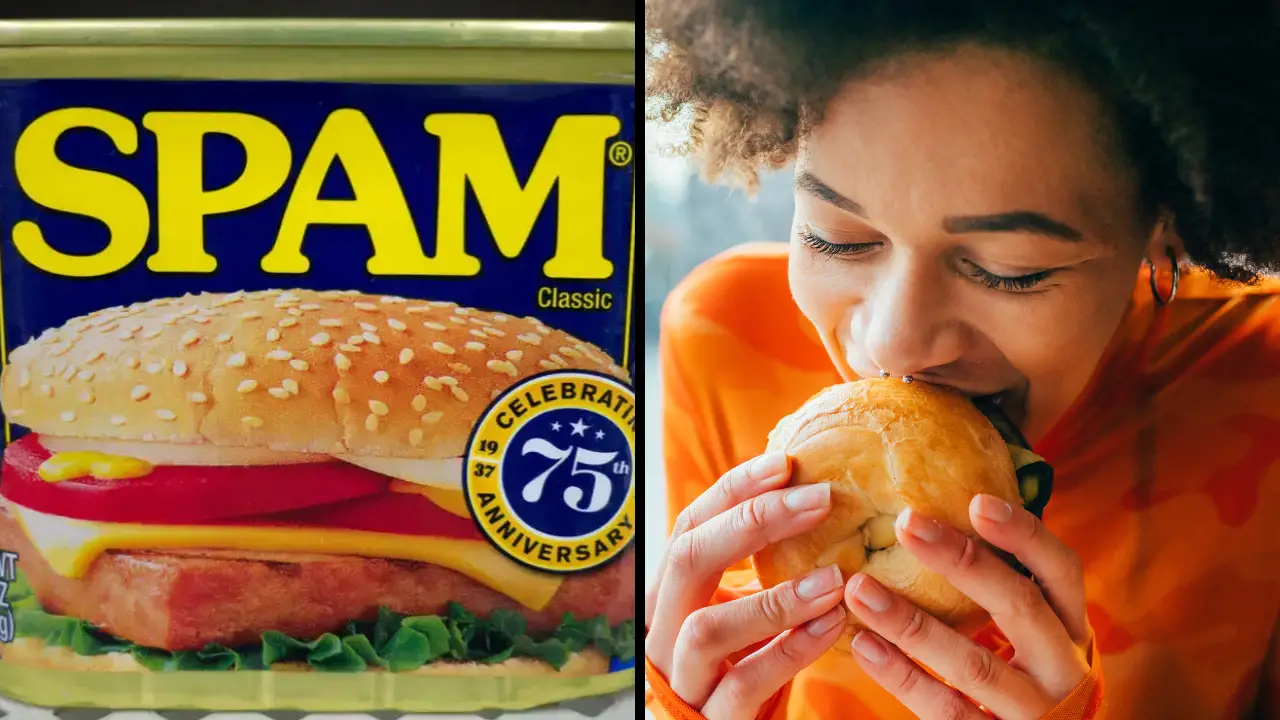
Credit: Alamy/Adobe Stock
People Are Just Realizing What SPAM Actually Means
SPAM is a comfort food loved by many, but as it turns out, very few people know what the name actually means.
The chances are you’ll have heard of SPAM, and there’s a pretty good chance you’ll have eaten it at one time or another, whether in a sandwich, on a fry up or even on top of a pizza.
The famous canned meat product that has been a pantry staple for generations. While many people recognize the iconic blue-and-yellow tin instantly, fewer know the story behind its name.
And as it turns out, plenty of people have been guessing wrong for years.
The surprising history behind SPAM
SPAM first appeared on store shelves in 1937, launched by Minnesota-based company Hormel Foods. Over the decades, it has become one of the most recognizable canned food products in the world.
Despite often being referred to as a “mystery meat,” its ingredients are actually straightforward. The product is made from pork, water, salt, potato starch, sugar, and sodium nitrate.
According to TIME, Hormel originally marketed SPAM toward homemakers looking for affordable, convenient meals that could be prepared quickly without much effort.
However, convincing shoppers to embrace the product wasn’t easy. Many consumers were hesitant to buy meat that could sit safely on a shelf without refrigeration, making it difficult for SPAM to gain traction during its early years.
How World War II transformed its popularity
While SPAM struggled to find widespread success initially, World War II dramatically changed its fortunes.
As fresh meat became difficult to transport to troops stationed around the world, SPAM emerged as a practical solution. Its long shelf life and ease of transportation made it a valuable food source for military personnel.
By the time the war ended, more than 150 million pounds of SPAM had been purchased by the military.
The product’s influence extended far beyond military bases. During the war years, SPAM was introduced to several Pacific regions, including Guam, Hawaii, Okinawa, and the Philippines.
Its impact was significant. According to The Atlantic, the canned meat quickly became integrated into local cuisines and even became part of “Filipino identity.”
Today, SPAM remains especially popular in many of these locations, where it continues to feature in a wide variety of traditional and modern dishes.

The internet’s funniest theories about the name
Although SPAM has been around for nearly nine decades, people have continued to speculate about the meaning behind its unusual name.
The mystery has inspired countless theories online, with some suggestions sounding surprisingly believable and others leaning firmly into humor.
One user online explained: “On a whim, I purchased canned meat. With the first taste, I understood SPAM was an acronym for Salt Preserves Any Meat.”
Another said that they believed SPAM was an acronym for ‘Sizzle Pork And Mmm’.
A third person suggested: “I was once told it stood for special pressed American meat.”
“Some Parts Are Meat – and I’ll still eat it,” theoried another person.
These creative interpretations have circulated for years, helping fuel curiosity about the product’s true origins.
What SPAM actually stands for
Despite the many theories, none of them are correct.
According to TIME, the name was reportedly created by actor Ken Daigneau, who was the brother of a Hormel executive. He entered a company naming contest and won a $100 prize after suggesting the now-famous name.
The story goes that when Daigneau first proposed the word, Hormel founder Jay Hormel immediately recognized its potential. As reported by Eater, he later recalled: “I knew then and there that the name was perfect.”
So what does SPAM actually stand for? Contrary to popular belief, it is not an acronym at all.
The name is simply a portmanteau, a blended word created by combining parts of two words. In this case, SPAM comes from ‘spiced ham.’
After decades of speculation and countless creative guesses, the answer is surprisingly simple. While ideas such as ‘Salt Preserves Any Meat’ and ‘Sizzle Pork And Mmm’ may be entertaining, the iconic name ultimately comes from nothing more complicated than a shortened version of spiced ham.
Related Article: Experts Explain Why More And More People Are Getting The ‘Chicken Ick’
Related Article: Food Expert Issues Warning To People Who Cook Bacon In An Air Fryer
Want more stuff like this?
Get the best viral stories straight into your inbox!
