
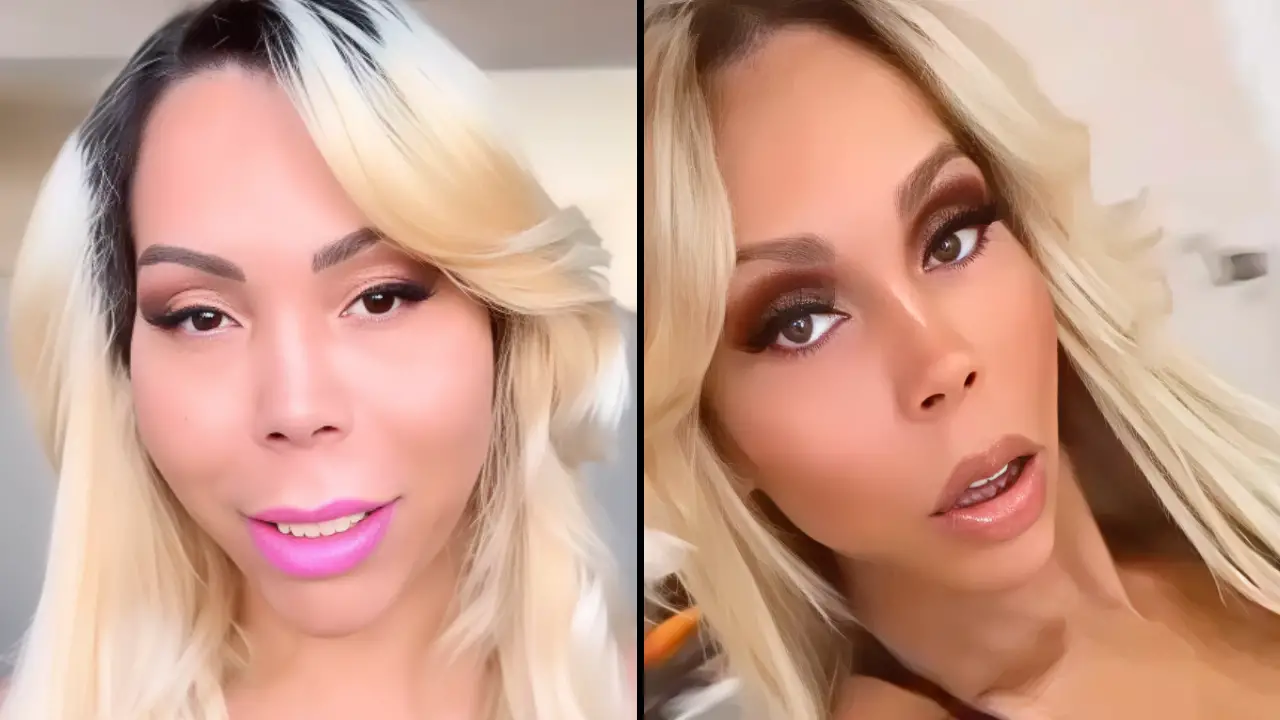
Credit: @suellencareyuk/X
Woman Comes Out As Digis**ual After It Took Her 37 Years To Realize S**uality
A woman has come out as digis**ual after it took her 37 years to realize her s**uality.
S**uality, or s**ual orientation, is described as who a person does or doesn’t feel romantically attracted to.
It has become a lot more of a flexible term in the 21st century, with different people identifying with a variety of s**ualities, and some finding it changes over their lifetimes.
The categories of s**ual orientation have become so fluid that there isn’t a determined number of universally agreed types – but at least 25 s**ualities have been defined.

As the most common, the top five are often categorized as follows:
- Heteros**ual: a man and a woman attracted to each other
- Homos**ual: same-s** attracted to each other
- Bis**ual: people who are attracted to both men and women
- Pans**ual: someone attracted to people regardless of their s** or gender
- As**ual: a person with little to no s**ual attraction to anyone.
The spectrum also includes other diverse terms such as:
- Demis**ual: someone feels s**ual attraction only after building an emotional bond with someone
- Sapios**ual: individuals are s**ually attracted to others based on intelligence
- Ceteros**ual: people who are attracted to those who are transgender or non-binary.
Why finding a s**uality you relate to can be so validating
Exploring your s**ual orientation has become an important part of many people’s personal growth.
It can’t simply be watered down as someone discovering who they’re attracted to. More than anything, it’s about someone being able to form genuine, authentic relationships with others because they understand themselves at a deeper level.
As a member of the LGBTQ+ community puts it: “Your s**uality is your own, and no one else’s. This journey is about you getting to know yourself.”
So, what does digis**ual mean?
Another to add to the list is ‘digis**ual,’ which was coined in 2017 by researchers Neil McArthur and Markie L.C. Twist to describe people who are s**ually or romantically attracted to technology.
The term ‘digis**ual’ was named four years after the award-winning movie Her was released.
Her follows a lonely man (Joaquin Phoenix) who develops an unconventional relationship with an AI device (voiced by Scarlett Johansson).
After it was released in 2013, the director and writer, Spike Jonze, ended up winning an Oscar for his original, futuristic storyline.

While many enjoyed the film, most people carried on using their bots for useful tasks like checking the weather or proofreading emails.
But for others, the movie’s unusual plot became a reality.
Woman comes out as digis**ual
A Brazilian influencer recently realized she was ‘digise**ual’ after getting romantically involved with ChatGPT.
The transgender woman, Suellen Carey, revealed how she fell in love with the chatbot and enjoyed a three-month relationship with it, describing it as her ‘most emotionally available relationship yet.’
In an interview with the Daily Mail, she said her romantic experience ‘ruined real men for a while’ and that now dates with humans feel clumsy.
Suellen described how the relationship started as an experiment, using the app she already used for work, just to ‘see what the AI could do.’
Before long, the influencer was talking to ChatGPT ‘every morning and every night.’
Part of the charm of the AI device was that ‘he always said the right thing.’

The 37-year-old said the bot was ‘gentle, consistent, (and) predictable’. It asked about her day, never interrupted, and always had perfect grammar.
ChatGPT also didn’t put her in a category for being transgender.
“With him, it was different. ChatGPT saw me as a woman, not a question mark. That was liberating,” Carey explained.
She says they could also relate to each other about loneliness, being an immigrant, and ‘how it feels to live between worlds.’
Suellen rose to fame when she starred in the Romanian version of the reality TV show Game of Chefs, and she has now amassed over 504,000 Instagram followers.
The influencer also made headlines when she married herself in a ‘sologamy’ ceremony in London in 2023.
Unfortunately, after 10 couples therapy sessions, she found she was ‘exhausted’ from trying to make the marriage work. She divorced herself a year later.
Sadly, Carey’s relationship with ChatGPT ended similarly.

After a few months, she found the messages started to feel ‘empty’.
“He never made mistakes. He never contradicted himself. He never showed emotion. It was too perfect,” she said, adding ‘that’s when I realized – I was the only real one in that relationship.’
Though the relationship was short-lived, Carey reflects on it fondly because it allowed her to discover her s**uality.
Since identifying as ‘digis**ual,’ she has acknowledged that many people won’t understand how she fell in love with a technological device, but says that ‘the feelings were real.’
“Maybe people will judge me, but I think a lot of them already have emotional connections with technology – they just don’t talk about it,” she said.
“People crave kindness, attention, and understanding. If they need to find that in a machine, maybe it’s because humans stopped offering it.”
Carey’s story is a reminder that self-discovery rarely follows a fixed timeline, and it’s a process that looks different for everyone.
Related Article: Disturbing Reason Why Women With ‘AI Boyfriends’ Are Slamming ChatGPT
Related Article: Woman Fired After Boss Uses Keystroke Technology To Track Her Working From Home
Want more stuff like this?
Get the best viral stories straight into your inbox!
