
Credit: NASA
Artemis II About To Enter Most Dangerous Phase Of Mission – But There’s One Major Problem
Artemis II is about to mention the most dangerous phase of its mission, but there’s one major problem.
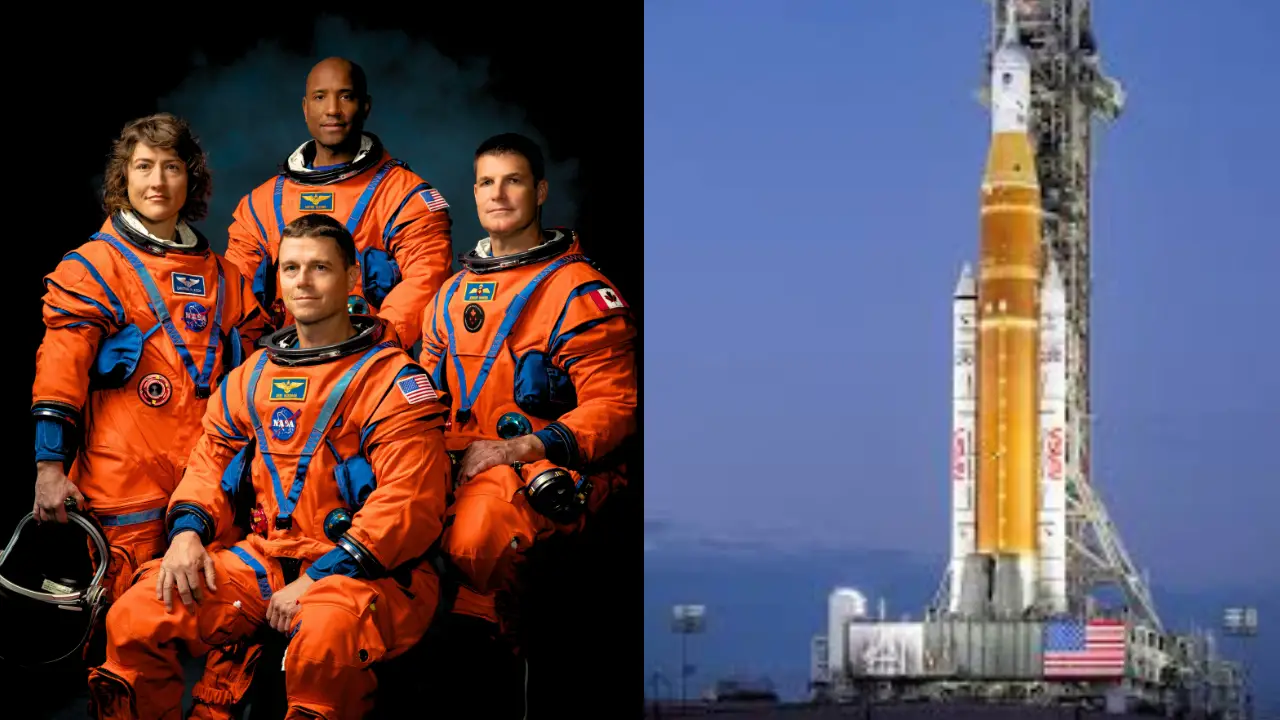
The crew of Artemis II is preparing to face the most perilous part of their historic journey—and it’s not the trip around the Moon, but the final minutes before they return home.
After 10 days in deep space, astronauts from NASA and the Canadian Space Agency are set to plunge back through Earth’s atmosphere at speeds approaching 24,000mph.
Waiting for them is a fiery descent that will push both human endurance and spacecraft engineering to the limit.
The mission has been smooth – so far
The Artemis II mission has largely gone according to plan. Commander Reid Wiseman, alongside Victor Glover, Christina Koch, and Jeremy Hansen, have successfully completed a lunar flyby—travelling farther from Earth than humans have in decades, per NBC.
Aside from minor onboard issues, including a malfunctioning space toilet, the spacecraft has performed as expected. But as the crew begins their return journey, attention has shifted to the one phase that leaves no margin for error: re-entry.
A 15-minute window of danger
Re-entry is widely regarded as one of the most dangerous stages of any space mission.
As the Orion capsule slams into the atmosphere, friction with the air generates temperatures of up to 2,800°C—hot enough to melt metal, per MailOnline.
During this roughly 13 to 15-minute window, the spacecraft must slow from hypersonic speeds to a safe landing velocity, deploy parachutes at precisely the right moment, and maintain a perfectly calculated angle of descent.
Even the smallest deviation could have catastrophic consequences.
To make matters more intense, communication with the crew will temporarily black out as plasma builds up around the capsule, cutting off contact with mission control for several minutes.
The heat shield under scrutiny
At the centre of the concern is the Orion spacecraft’s heat shield—the critical layer designed to protect the astronauts from burning up during re-entry, the Sun reports.
This shield is made from a material known as Avcoat, which is designed to absorb and dissipate extreme heat by gradually burning away. It acts as the only barrier between the crew and temperatures comparable to half the surface of the Sun.
However, during the uncrewed Artemis I mission, the heat shield did not behave as expected. Engineers discovered cracks had formed, and chunks of material had broken off during re-entry.
Investigations later revealed that gases trapped within the material caused pressure to build up, leading to the damage.
A new approach, but not a new shield
Despite identifying the issue, NASA did not redesign the heat shield in time for Artemis II. Instead, engineers opted to modify the spacecraft’s re-entry trajectory to reduce risk.
Unlike Artemis I, which used a ‘skip re-entry’ manoeuvre—briefly bouncing off the atmosphere to slow down—the Artemis II capsule will take a steeper, more direct path back to Earth.
This approach reduces the time the heat shield is exposed to extreme temperatures, theoretically lowering the chance of failure.
Officials say they are confident in this strategy, and the crew themselves have expressed trust in the revised plan.
Experts warn of unanswered questions
Not everyone is convinced the changes go far enough.
Some experts have raised concerns that the root cause of the heat shield’s failure may not be fully understood. Charlie Camarda has warned that the issue shares similarities with past spaceflight disasters, where risks were underestimated or misunderstood.
The concern is not just about whether the heat shield can withstand the heat, but whether its behaviour under real re-entry conditions can be accurately predicted. Much of the testing conducted since Artemis I has been limited to small-scale samples, rather than full-system simulations.
That uncertainty has left some questioning whether altering the flight path alone is enough to guarantee safety.
A high-stakes return to earth
As the Orion capsule begins its descent, it will detach from its service module, orient itself heat shield-first, and begin its fiery plunge.
Within minutes, the spacecraft must survive extreme heat, intense pressure, and rapidly changing forces.
At around 6,000 feet, parachutes will deploy in sequence to slow the capsule before it splashes down in the Pacific Ocean off the coast of California.
Recovery teams will then move in to retrieve the astronauts, marking the end of a mission that has pushed the boundaries of human spaceflight.
The one problem no one can ignore
Despite all the planning, engineering, and analysis, there is one reality that continues to loom over the mission.
As Jared Isaacman admitted, the safe return of the crew ultimately depends on a single system working exactly as intended.
There is no backup heat shield. No alternative method of protection. No second chance if something goes wrong.
In the final moments of Artemis II, everything comes down to that one piece of technology—and whether it holds.
Related Article: NASA Astronaut Reveals The Shocking Truth He Learned After Seeing Earth From Space
Related Article: Astronaut Who Spent 178 Days In Space Shares The Big ‘Lie’ He Realized After Seeing Earth
Want more stuff like this?
Get the best viral stories straight into your inbox!
