
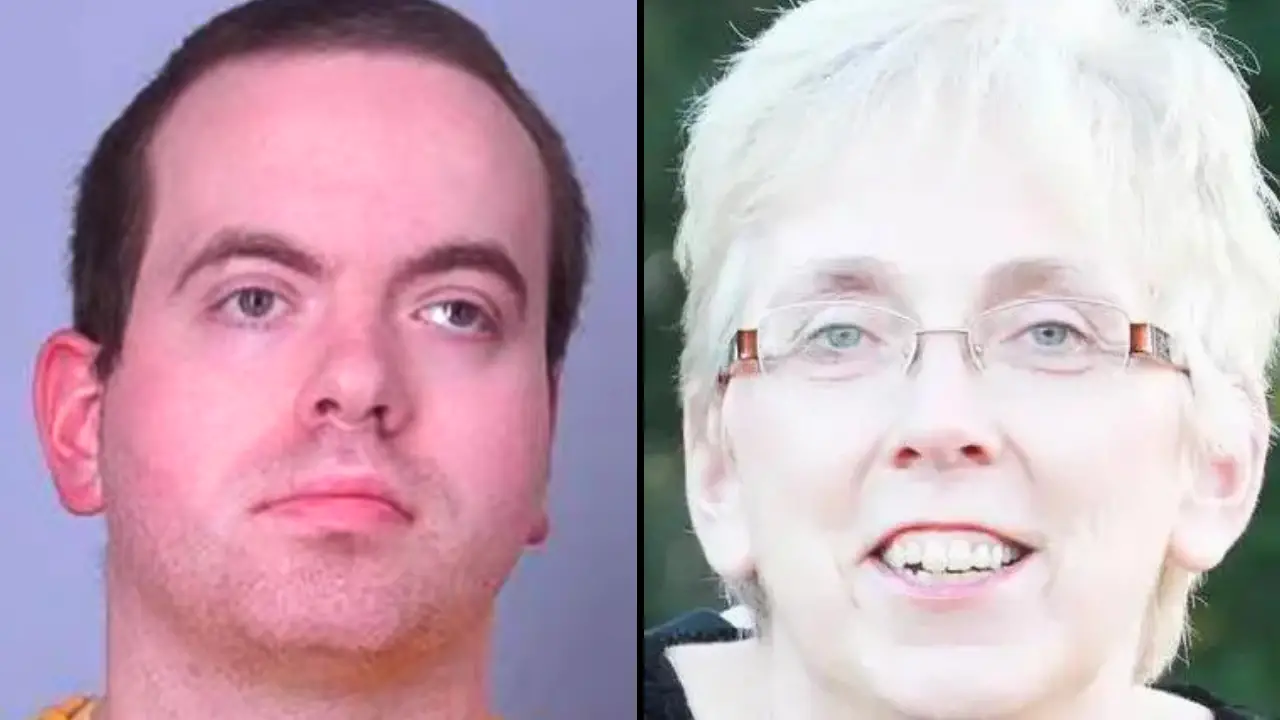
Credit: Sherburne County Sheriff's Office
Man Convicted Of Killing And Eating His Mom Reveals Why He Did It
A man convicted of killing and eating his mom has revealed why he did it.
The quiet community of Big Lake, Minnesota, was shaken to its core by a crime so disturbing that even seasoned investigators struggled to process what they encountered.
At the center of the case was Eric Leif Jordahl, a 26-year-old man who would later be convicted of murdering his mother, Rosalie ‘Rose’ Johnson — a respected local official — in an act of violence that escalated into cannibalism.
The case drew national attention not only because of its brutality, but because of the deeply unsettling details that emerged in court documents and witness accounts.
It was a crime that seemed to defy logic, leaving many asking the same question: how could something like this happen inside an ordinary family home?
Only after years of legal proceedings, psychological evaluations, and courtroom testimony did a clearer — though still deeply troubling — picture begin to emerge.
A respected life cut short
Rosalie Johnson, 62, was known throughout Big Lake as a dedicated public servant and active community member, per the New York Post.
Appointed to the City Council in 2019, she was involved in numerous local initiatives, including education programs and environmental efforts tied to the area’s lakes.
Friends and colleagues described her as thoughtful, engaged, and warm. One fellow council member later reflected: “She was brilliant and a joy to work with. Her presence made everything a little lighter.”
Her life was rooted in service — not just in politics, but in community building. She worked with youth organizations and local committees, leaving behind a legacy that extended far beyond her official role.
That legacy made the events of July 23, 2020, all the more shocking.
The night everything changed
According to court findings reported by the Chronicle, the fatal incident began inside the family home in Sherburne County during the early hours of the morning. What started as a routine interaction between mother and son quickly spiraled into violence.
Jordahl later admitted that he entered his mother’s bedroom while she was asleep. At some point, she told him to go back to bed — a seemingly ordinary parental instruction.
What followed, however, was anything but ordinary.
Prosecutors described a sudden and intense attack. Jordahl struck his mother repeatedly, escalating from physical blows to the use of objects as weapons. He later retrieved a knife, which he used during the assault.
Investigators would later determine that the attack was prolonged and extremely violent, leaving the home in a state of devastation.
By the time it was over, Rosalie Johnson was dead.
A father’s horrific discovery
Hours later, Jordahl’s father, Andrew Jordahl, returned home from work — unaware that his life was about to change forever.
When he entered the garage, he encountered a scene that would later be described in court as deeply disturbing. His son was there, covered in blood, behaving erratically.
According to official documents, Eric made a chilling statement almost immediately.
Alarmed and confused, Andrew entered the house, where he discovered clear signs that something horrific had taken place. Realizing the severity of the situation, he quickly called emergency services.
Responding officers would later report finding evidence of violence throughout the home, including blood, tissue, and weapons. The scene confirmed what Jordahl had already admitted.
Inside the investigation and trial
The case moved swiftly into the legal system, where it would become one of the most disturbing prosecutions in the state’s recent history.
Jordahl was charged with multiple counts, including first-degree murder — a charge that carries an automatic life sentence in Minnesota. Prosecutors argued that the killing was intentional, pointing to evidence that he retrieved a weapon and continued the attack over time, MSN reports.
During interviews with law enforcement, Jordahl provided details about the assault, admitting to striking, stabbing, and biting his mother. Authorities also concluded that acts of cannibalism occurred after — and possibly during — the attack.
The defense, however, pursued a different angle.

Jordahl’s attorneys argued that he should not be held criminally responsible due to severe mental illness. They sought a verdict of not guilty by reason of mental illness, which would result in confinement in a secure psychiatric facility rather than prison.
This led to a bifurcated trial process — one phase to determine guilt, and another to assess mental responsibility.
Ultimately, Jordahl was convicted of first-degree murder, confirming the court’s view that the killing met the legal threshold for intent and premeditation.
A community in mourning
While the legal battle unfolded, the Big Lake community focused on honoring Rosalie Johnson’s life.
Three months after her death, friends, family, and colleagues gathered at Lakeside Park to dedicate a memorial bench in her name. The quiet setting, overlooking the water, was chosen as a place for reflection — something those who knew her felt she would have appreciated.
“It’s the perfect memorial,” one colleague said at the time. “A place for conversation, reflection and relaxation.”
The tribute stood in stark contrast to the violence of her death — a reminder of the life she lived rather than the way it ended.
Yet even as the community grieved, many struggled to understand what had driven her son to commit such an act.
The question everyone asked
Throughout the investigation and trial, one question lingered above all others: why?
What could possibly lead a person to attack their own parent with such ferocity — and then go even further?
Early reports pointed to the immediate trigger: a simple instruction to go to bed. But investigators and psychologists alike knew that such a minor interaction could not, on its own, explain the scale of the violence.
Attention turned instead to Jordahl’s mental state.
Court records and testimony revealed that he had exhibited unusual behavior in the past. There were indications that he had experienced disturbing thoughts and possible delusions prior to the incident.
He even admitted during interviews that he had previously considered harming his mother, though not to the extent that ultimately occurred.
Still, the full explanation remained unclear — until Jordahl himself provided insight.
His explanation revealed
In statements made both at the scene and later during questioning, Jordahl repeatedly returned to a single idea.
He believed he was possessed, Oxygen claims.
“The devil exists, it’s in me,” he said — a phrase that would become central to understanding his mindset.
According to his own account, he felt as though something external had taken control of his actions. He described the attack not as a calculated decision, but as something driven by a force he could not resist.
This belief formed the foundation of his defense’s argument. They contended that Jordahl’s actions were the result of severe mental illness, potentially involving psychosis or delusional thinking.
From a clinical perspective, such claims are not unheard of in extreme cases. Individuals experiencing certain psychiatric conditions may develop fixed beliefs that they are controlled by external entities or forces.
However, the legal system requires more than belief — it requires proof that a defendant could not understand the nature or wrongfulness of their actions.
In Jordahl’s case, the court ultimately determined that, despite his claims, he was legally responsible.
Related Article: Death Row Inmate Suffered ‘Excruciating’ Execution After Making Last Meal ‘Mistake’
Related Article: Woman Who ‘Died And Came Back To Life’ Explains What Afterlife Is Like
Want more stuff like this?
Get the best viral stories straight into your inbox!
