
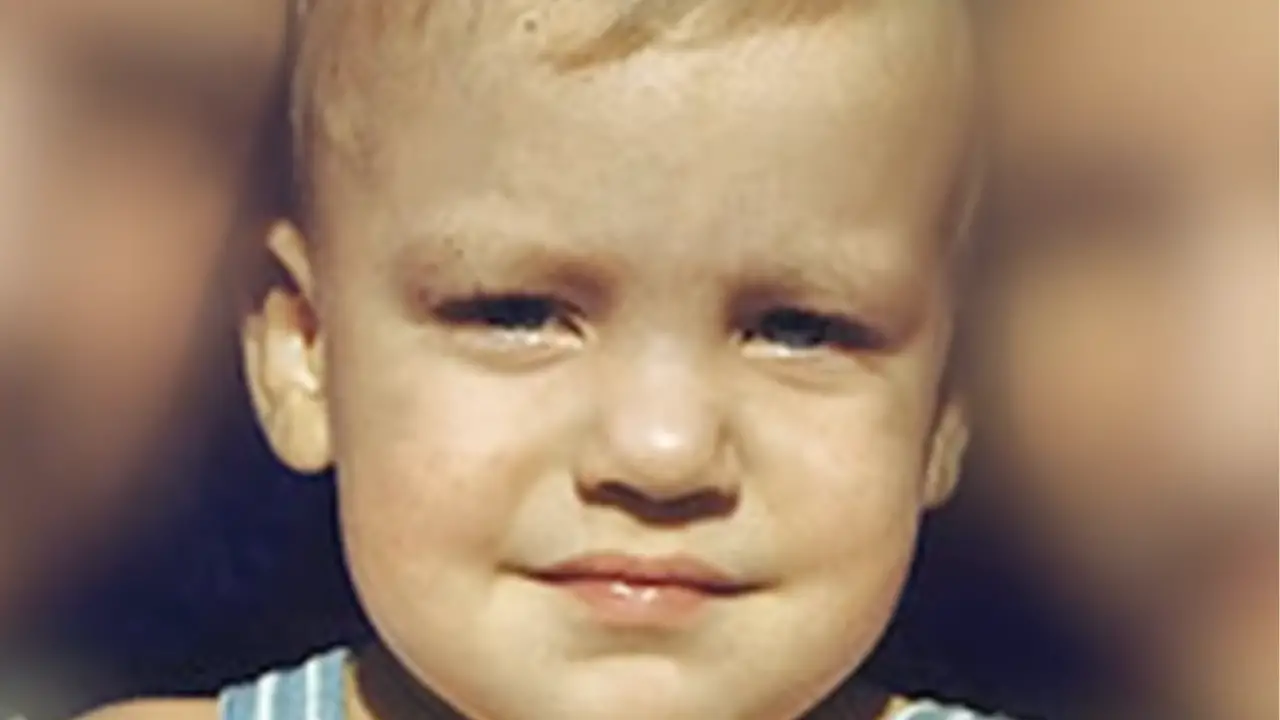
Credit: Good Mythical Morning via YouTube
This Baby Grew Up To Be One Of The Most Evil Men On Earth
The sweet-looking baby in this photo grew up to be one of the most evil men on the planet.
He was known, without affection, as a ‘walking brain.’ He played trombone in the marching band. He skipped grades. He got into Harvard at 16. His neighbors described his parents as people who ‘sacrificed everything they had for their children.’
By every visible metric, this was a child who had been given extraordinary gifts and an extraordinary chance at life.
What he did with those gifts would shock the world and leave a trail of death, mutilation, and terror spanning nearly two decades.
A prodigy from the start
He was born on May 22, 1942, in Chicago, Illinois, to working-class Polish-American parents — his father a sausage maker, his mother a woman who poured her entire self into her children’s futures.
He had a younger brother, David, who would later play a pivotal role in bringing him to justice.
From his earliest years at Sherman Elementary School, administrators described him as healthy and well-adjusted.
When the family relocated to Evergreen Park, Illinois, and he was tested, his IQ came back at 167. He skipped the sixth grade — a decision that would, by his own later account, prove transformative in the worst possible way.
Before the skip, he had friends. He was even seen as a leader. Afterward, thrown in with older children who bullied him mercilessly, he withdrew. The ‘walking brain’ label stuck.
At Evergreen Park Community High School, he skipped the eleventh grade too, graduated at 15, and was accepted to Harvard University on a scholarship.
A classmate later recalled he was ’emotionally unprepared’ for the leap. “They packed him up and sent him to Harvard before he was ready,” the classmate said. “He didn’t even have a driver’s license.”
Harvard, Michigan, and a career that could have been
At Harvard, he lived quietly in a small dormitory designed for the youngest and most precocious freshmen. Housemates described him as very intelligent but socially reserved.
He earned his Bachelor of Arts in mathematics in 1962. But his Harvard years contained something darker than loneliness: in his second year, he was enrolled in a psychological study led by researcher Henry Murray, in which subjects were subjected to what Murray himself described as ‘vehement, sweeping, and personally abusive’ attacks on their personal beliefs, designed to humiliate and destabilize them.
He spent 200 hours as part of this study. His lawyers would later attribute some of his hostility toward mind control and institutional authority to the experience.
From Harvard, he moved to the University of Michigan, where he earned his master’s and doctoral degrees in mathematics.
His dissertation, on a subject in geometric function theory, won Michigan’s prize for best mathematics dissertation of the year. His doctoral advisor called it ‘the best I have ever directed.’ Another professor said simply, “It is not enough to say he was smart.”
In late 1967, aged just 25, he became an assistant professor at the University of California, Berkeley — the youngest in the institution’s history. He was on track for tenure.
And then, without warning, on June 30, 1969, he resigned. The department chairman later wrote that the resignation was ‘quite out of the blue’ and that he had ‘seemed almost pathologically shy’ and had made no close friends.
Efforts to integrate him into the life of the department had quietly failed.
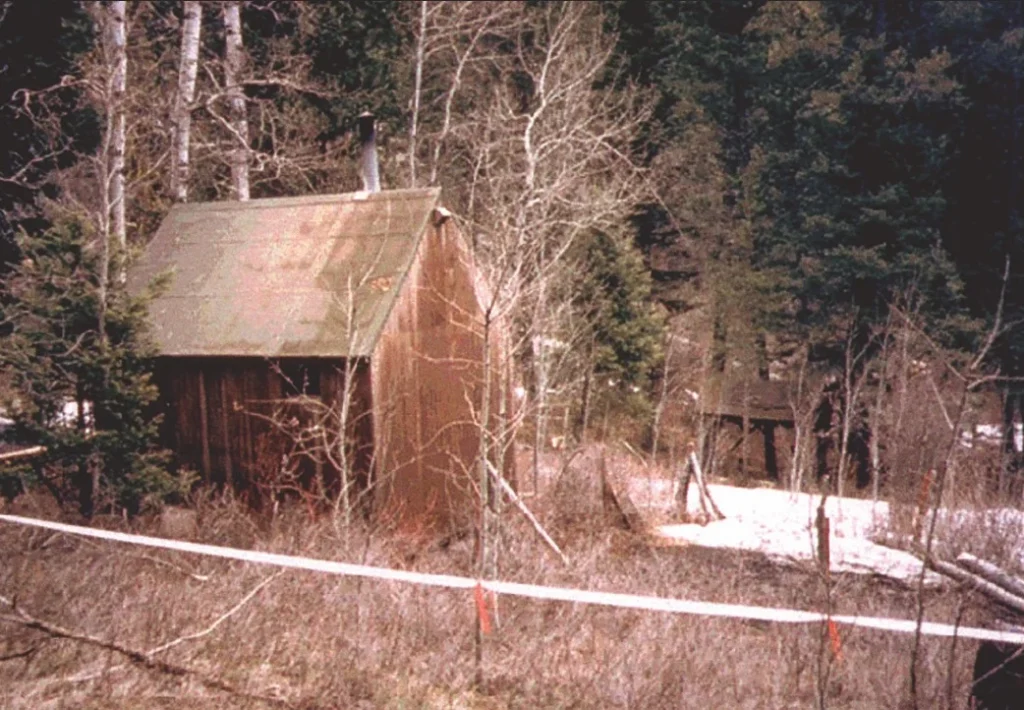
The cabin in Montana
After resigning from Berkeley, he spent time at his parents’ home in Illinois before making the decision that would define everything that followed.
In 1971, he moved to a remote cabin he had built himself near Lincoln, Montana — no electricity, no running water, a bed, two chairs, some trunks, a gas stove, and lots of books.
His stated goal was self-sufficiency. He rode an old bicycle to town. He read classic works in their original languages at the local library. He grew his own food. For a time, it appeared to be a man simply choosing a different kind of life.
But the wilderness around him was changing. In the summer of 1983, he returned to a favorite wild plateau he had hiked to many times, and found a road cut straight through the middle of it.
He described the moment in later interviews as a turning point — the moment he decided that living in harmony with nature was no longer possible, and that the only response was revenge against the industrial system he blamed for its destruction.
“It was from that point on I decided that, rather than trying to acquire further wilderness skills, I would work on getting back at the system,” he said.
He had already been committing acts of sabotage near his cabin since 1975 — arson, booby traps against nearby developments. He had been reading obsessively in sociology and political philosophy, particularly the work of French philosopher Jacques Ellul, whose book The Technological Society had become, in his brother David’s words, his ‘Bible.’
What came next was not a sudden eruption. It was a slow, deliberate, methodically planned campaign of terror.
Seventeen years of murder
Between 1978 and 1995, he mailed or hand-delivered sixteen increasingly sophisticated bombs to targets across the United States. He selected victims through library research, choosing people he believed were advancing the destruction of nature through technology.
Universities, airlines, computer stores, advertising executives — all were targets in a campaign that killed three people and injured 23 others.
His first bomb, in May 1978, was found in a parking lot at the University of Illinois at Chicago and injured a university police officer when it detonated. His second, placed at Northwestern University the following year, injured a graduate student.
A third device, placed aboard American Airlines Flight 444 in 1979, released smoke mid-flight and forced an emergency landing — authorities later said it had enough power to have destroyed the plane entirely.
The victims who suffered most grievously include John Hauser, a graduate student and Air Force captain who lost four fingers and the sight in one eye in 1985.
Computer science professor David Gelernter lost sight in one eye, hearing in one ear, and the use of his right hand after opening a package bomb mailed to his Yale University office in 1993. Geneticist Charles Epstein lost several fingers to a bomb delivered to his home the same year.
Three people died. Computer store owner Hugh Scrutton, killed in Sacramento in 1985. Advertising executive Thomas Mosser, killed at his home in New Jersey in 1994. And Gilbert Brent Murray, president of the California Forestry Association, killed in his Sacramento office in April 1995 by a package addressed to his predecessor.
The FBI’s investigation became the longest and most expensive in the bureau’s history up to that point, ultimately consuming more than $50 million and involving over 150 full-time personnel.
For nearly two decades, investigators came up empty. The bombs were built from scrap materials available almost anywhere.
Fingerprints found on some devices did not match. False clues had been deliberately planted. He took extreme care leaving nothing that could identify him.
The manifesto — and the brother who read it
In 1995, he sent letters to media outlets demanding that a major newspaper publish his 35,000-word essay — a sprawling social critique titled Industrial Society and Its Future — in full, promising to ‘desist from terrorism’ if the demand was met.
After extensive debate about the wisdom of capitulating to a terrorist, FBI Director Louis Freeh and Attorney General Janet Reno recommended publication, hoping a reader might recognize the author. The Washington Post published it in September 1995.
Thousands of tips flooded in. One stood out above all others, who upon reading the manifesto a week after its publication, recognized something in the prose — the phrasing, the arguments, the particular patterns of thought.
He searched through old family papers and found letters his brother had sent to newspapers in the 1970s using strikingly similar language. After agonizing deliberation, he contacted the FBI.
FBI linguistic analyst James Fitzgerald compared the manifesto to their earlier writings and concluded they were almost certainly by the same hand.
Combined with the geographic profile the bureau had already developed — Chicago childhood, Berkeley connection, Salt Lake City residence — the analysis provided the basis for a search warrant.
Arrest, trial, and death
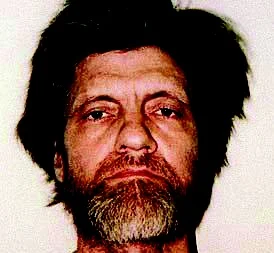
On April 3, 1996, FBI agents arrested the man at his cabin in Montana. He was unkempt, rail-thin, and entirely alone.
Inside the cabin, agents found bomb components, 40,000 handwritten journal pages detailing his experiments and crimes, improvised firearms, and one live bomb ready for mailing.
His journals left nothing to the imagination. He numbered his bombing experiments — ‘Experiment 97,’ which killed Hugh Scrutton; ‘Experiment 244,’ which killed Thomas Mosser.
He noted technical details, chemical mixtures, modifications made to increase lethality. He expressed frustration at non-lethal outcomes and satisfaction when devices caused deaths. A 1971 entry stated his motive plainly: “My motive for doing what I am going to do is simply personal revenge.”
He pleaded guilty in January 1998 and was sentenced to several consecutive life terms without the possibility of parole at ADX Florence, the federal Supermax prison in Colorado.
In prison, he formed an unlikely friendship with Ramzi Yousef and Timothy McVeigh — the perpetrators of the 1993 World Trade Center bombing and the 1995 Oklahoma City bombing respectively.
In 2021, he was diagnosed with rectal cancer. He declined all treatment in March 2023 after months of chemotherapy and a poor prognosis. In May 2023, a prison oncologist noted he was ‘depressed.’
In the early hours of June 10, 2023, he was found unresponsive in his cell, having hanged himself from a handicap rail with a shoelace. Resuscitation efforts were made. He was transferred to Duke University Hospital in North Carolina, where he was pronounced dead at 8:07 a.m. He was 81 years old.
The baby in the family photographs, the gifted boy from the working-class Chicago home, the Harvard prodigy, the youngest assistant professor in Berkeley’s history — he was Theodore (Ted) John Kaczynski, the Unabomber.
Related Article: This Little Girl Grew Up To Be The Most Evil Woman In History
Related Article: This Little Boy Grew Up To Be One Of The Most Famous Actors In The World
Want more stuff like this?
Get the best viral stories straight into your inbox!
