
Credit: Adobe Stock
Urgent Warning Issued If You See These Innocent-Looking Emojis On Your Child’s Phone
An urgent warning has been issued to any parent who sees these emojis on their children’s phones.
Most parents think they know what their children are talking about online. Most parents are wrong.
In an age where digital communication moves faster than any adult can keep up with, young people have developed a sophisticated parallel language — one built not from words, but from tiny images that appear on every phone screen, every day.
And according to police forces, some of those images carry meanings that no parent would expect.
The show that opened everyone’s eyes
For many families, the wake-up call came from an unlikely source: a Netflix drama. Adolescence, the acclaimed British psychological crime series, follows 13-year-old Jamie Miller — played by Owen Cooper — who is arrested for the murder of a female classmate.
The show is unflinching in its examination of how misogynistic content circulates online, and how young boys can be radicalized by communities that promote deeply hostile attitudes toward women.
One of the most talked-about scenes features Jamie, in a police interview, calmly explaining to his father — played by Stephen Graham — what various emojis actually mean.
For millions of viewers, it was the first time they had ever heard of such a coded language existing, let alone being used by their own children.
Stephen Graham, who also co-produced the series, has spoken about why he felt compelled to make it. He said: “I just thought, what’s going on in society where this kind of thing is becoming a regular occurrence? I just couldn’t fathom it. So I wanted to really have a look and try and shine a light on this particular thing.”
His comments came after he had heard of two separate incidents in which boys had murdered girls — incidents he described as motivating his desire to explore what was happening in the minds of young men.
The response to the show was immediate and widespread. Parents across social media admitted they had started scrutinizing the emojis in their children’s messages in a way they never had before.
For many, it was a genuinely disorienting experience — realizing that symbols they had assumed were decorative shorthand were, in some contexts, functioning as a code.

What the emojis actually mean
So what should parents be looking out for? Police forces and child safety experts have begun publishing guidance in the wake of Adolescence, and the picture that emerges is both detailed and sobering.
Among the most significant areas flagged by Merseyside Police, per the Echo, who shared a comprehensive emoji guide with schools across their region, are symbols linked to incel ideology — the online community of so-called involuntary celibates, whose forums promote extreme hostility toward women and have been linked to real-world violence.
The pill emoji is one of the most notable examples. In the context of online incel communities, it references the concept of ‘taking the red pill’ — a metaphor drawn from the 1999 film The Matrix, in which accepting the red pill means seeing ‘the truth’ about reality.
Within the manosphere, this has been repurposed to mean accepting misogynistic beliefs about women and dating as the supposed truth about the world.
Dr Robert Lawson, a sociolinguistics expert at Birmingham City University, has explained: “In the manosphere, those who have been ‘red-pilled’ see the world as it really is, understanding the so-called ‘real’ nature of women’s behaviour and dating preferences.”
In Adolescence itself, Detective Inspector Bascome is told that the dynamite emoji represents an ‘exploding red pill’ — a signal that someone identifies as an incel.
The ‘100’ emoji is also flagged in the show, referencing the so-called ’80/20 rule’ — a belief common in incel communities that 80 percent of women are attracted to only 20 percent of men.
Jamie tells his father: “Women, you must trick them because you’ll never get them in a normal way.”
Heart emojis, which most people assume carry a straightforward meaning, turn out to have an entire secondary vocabulary depending on their color.
According to the show, red means love, purple carries a s**ual meaning, yellow signals mutual romantic interest, pink indicates interest without s**ual intent, and orange is a form of reassurance.
These are, it should be said, interpretations that can vary across different communities and platforms — but the broader point stands: color-coded communication is happening, and most parents have no idea.

The drug connection
While Adolescence focuses primarily on misogynistic radicalization, police guidance goes further, highlighting a separate but equally concerning area: emojis used to facilitate drug conversations and even drug dealing.
Surrey Police released a detailed guide on this subject in 2023, which has seen renewed circulation since Adolescence aired.
According to the guide, the horse emoji — which looks completely benign to most adults — can be used to reference ketamine, a drug also used in veterinary medicine to anaesthetize horses.
The link is not subtle once you know it, but to an uninformed parent glancing at a message thread, it is completely invisible.
Other drug-related emoji codes flagged by police include alien, demon mask, space invader, and skull and crossbones symbols, which can be used to refer to MDMA.
Cocaine is often represented through its street name ‘snow’ — hence snowflake and snowman emojis. A blowfish emoji may reference ‘blow,’ another nickname for the same drug.
Cannabis has perhaps the most elaborate emoji vocabulary of any substance, with symbols including dogs, cake, ice cream, lemons, purple grapes, maple leaves, four-leaf clovers, trees, and leaf emojis all potentially being used as references in different contexts.
The plug emoji — the type of electrical plug — is one of the most widely known coded symbols, used to refer to a drug dealer, commonly called ‘a plug.’
A broader code to be aware of
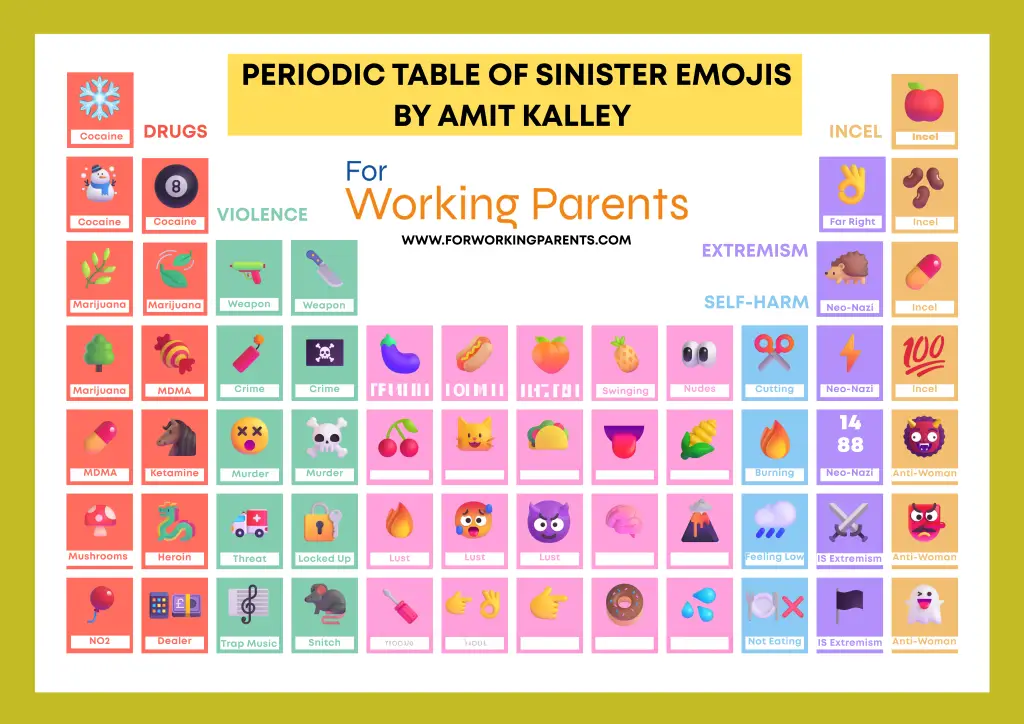
Beyond drugs and incel ideology, the Merseyside Police emoji table — which was shared through schools after Adolescence — covers a wide range of coded uses. In total, 60 emojis are flagged in the guide, with around 20 referencing s**ual content, 10 referencing violence, and others used in specific criminal contexts.
The rat emoji, for example, is flagged as a symbol for ‘snitch,’ the pirate flag for crime more broadly, and the ambulance emoji is described as potentially being used as a threat.
Amit Kalley, of For Working Parents — the organisation which helped develop the guide — explained his motivation for creating it.
“I created the emoji periodic table in response to Adolescence because I know how much parents are struggling to keep up,” he said. “From my time as a Deputy Headteacher to my work now supporting parents in the digital era, parents are finding the challenge of being present in their child’s online world too great.
“I wanted to raise awareness behind some emojis that can be used for sinister meanings so that parents can be aware and so they can have the much needed conversations with their children.”
Surrey Police put it clearly in their own statement: “What is vital in these discussions is trust. We’re very aware that checking phones could break down this trust between a parent and their child, and therefore we are not suggesting parents do this. Instead, we want people to be aware of what these emojis mean, in case they do happen to see them.”
Related Article: ‘Nose Cover’ Trend Young People Are Doing In Family Photos Has Finally Been Explained
Related Article: Parents Issued Urgent Warning To Not Post Photo Of Children With Emoji Faces Anymore
Want more stuff like this?
Get the best viral stories straight into your inbox!
