
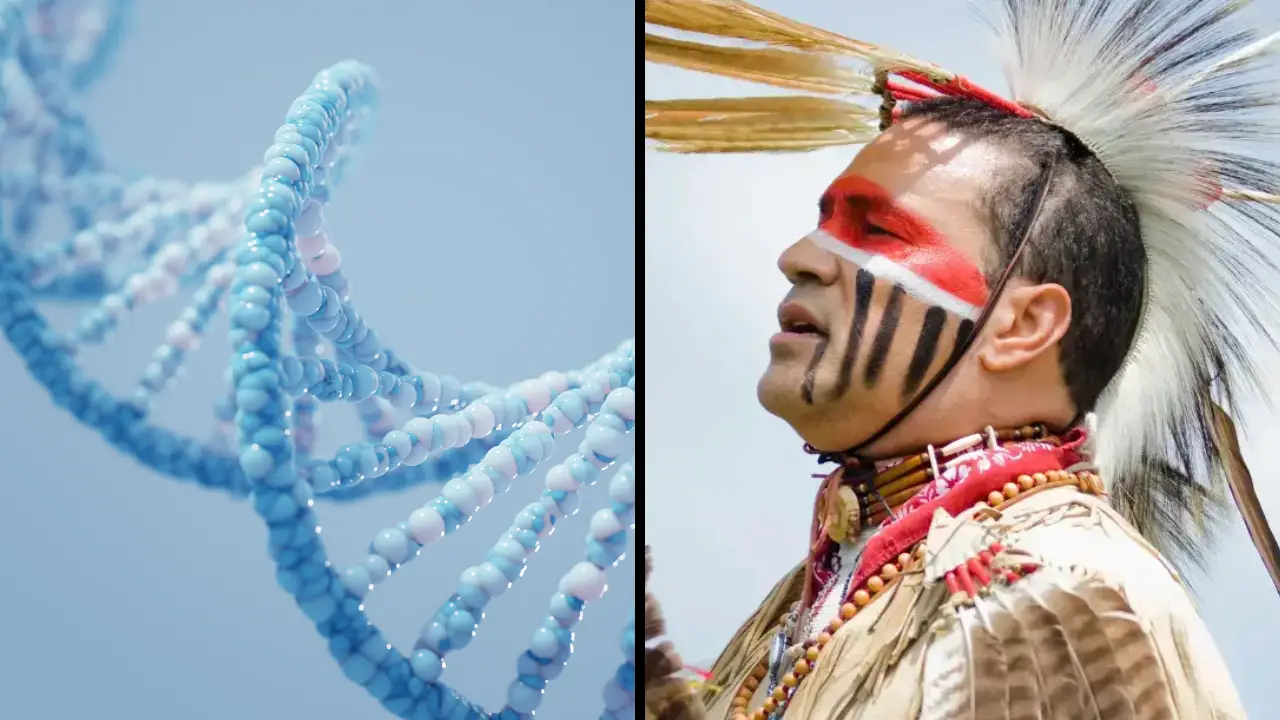
Credit: Adobe Stock/Alamy
DNA Evidence Sheds New Light About Where Native Americans Came From
The Native Americans first arrived in the Americas thousands of years ago, and new DNA research is offering fresh insights into their ancient origins.
For decades, researchers and historians have sought to understand how the first people reached the Americas long before European explorers arrived in 1492.
Now, a groundbreaking study may have brought us closer to an answer.
New DNA research reveals ancient migration routes
A study published in the journal Cell Reports analyzed mitochondrial DNA and uncovered evidence of two separate migration events linking the Americas with regions of present-day China and Japan.
According to the findings, these migrations took place during the last Ice Age and the period that followed as glaciers began to melt.
The research team successfully tracked a rare Native American ancestral lineage across continents and throughout thousands of years of human history.
To do this, scientists focused on mitochondrial DNA, which is inherited through the maternal line.
The researchers focused on a rare maternal genetic lineage known as haplogroup D4h, which has long been associated with some of the earliest Native American populations.
After examining around 100,000 modern DNA samples and 15,000 ancient samples, researchers identified 216 living individuals and 39 ancient individuals who shared the same genetic lineage.
The lineage was linked to founding populations across large parts of North and South America, including regions that are now California, Mexico, Peru, Chile, Bolivia, Brazil, and Ecuador.
Using carbon dating techniques alongside an analysis of genetic mutations that developed over time, the team was able to reconstruct the lineage’s movement and branching patterns.
Scientists uncover a more complex ancestry
Yu-Chun Li, a molecular anthropologist at the Chinese Academy of Sciences, said the findings suggest Native American ancestry is more intricate than previously understood.
“In addition to previously described ancestral sources in Siberia, Australo-Melanesia, and Southeast Asia, we show that northern coastal China also contributed to the gene pool of Native Americans,” she says.
The discovery adds another layer to scientists’ understanding of the populations that contributed to the ancestry of Indigenous peoples in the Americas.
Two migration waves may have shaped early America
Researchers believe the first migration event, referred to as a ‘radiation event,’ occurred between approximately 26,000 and 19,500 years ago.
At that time, harsh environmental conditions along northern coastal China may have forced human populations to relocate in search of more favorable living conditions.
Rather than disproving migration through Beringia, the findings support growing evidence that some of the earliest settlers may have followed a Pacific coastal route into the Americas.
Together, these movements may have played a significant role in shaping the genetic heritage of early Native American populations.
The second migration is thought to have taken place between 19,000 and 11,500 years ago, during a period when growing human populations began expanding into new regions with more suitable climates and resources.
The team noted that evidence from Y-chromosome DNA also suggests that male ancestors of Native Americans lived in northern China during the same period, strengthening the case for the migration theory.
Pacific coastal journey challenges previous theories
One of the most intriguing aspects of the study is the suggestion that both migration waves may have reached the Americas by traveling along the Pacific coastline.
This theory differs from the long-standing belief that early migrants crossed into North America via the Bering Land Bridge, which once connected parts of modern-day Russia, Alaska, and Canada.
Researchers also examined migration patterns and compared ancient tools such as spear points and arrowheads. These findings indicate that Paleolithic populations from China and Japan may have moved along the northern Pacific Rim before eventually reaching the Americas.
The results have renewed discussions about whether Native Americans could have descended from Japan’s ancient Jōmon people.
“In the terminal Pleistocene period, Japanese micro-blades, which exhibit similarities to those in Northeast Asia (including North China), display commonalities with contemporaneous stemmed points from incipient Jōmon sites,” the authors explain in the stury.
However, more recent genetic evidence has cast doubt on that theory, suggesting a direct Native American-Jōmon relationship is unlikely.
“Importantly, stemmed points were well distributed around the Pacific rim from Japan to South America with close affinities with each other. Recent findings on stemmed projectile points in North America […] show closer affinity to the nonfluted projectile points in Japan than to those in North Asia,” they continued.
“We attribute this similarity in Paleolithic technology, as well as the phylogenetic relationships of D4h sub-lineages in China, the Americas, and Japan, to a probable Pleistocene connection among these regions.”
Instead, the latest study proposes that the similarities observed between the groups may stem from a shared ancestral lineage rather than direct descent.
Despite the findings, researchers said many questions remain unanswered, including the exact location where the migrations began and what factors ultimately drove people to leave the region.
Related Article: American Woman Who Claims To Be Madeleine McCann Has DNA ‘Proof’
Related Article: Couple Sues IVF Clinic After DNA Test Reveals Baby Isn’t Theirs
Want more stuff like this?
Get the best viral stories straight into your inbox!
