
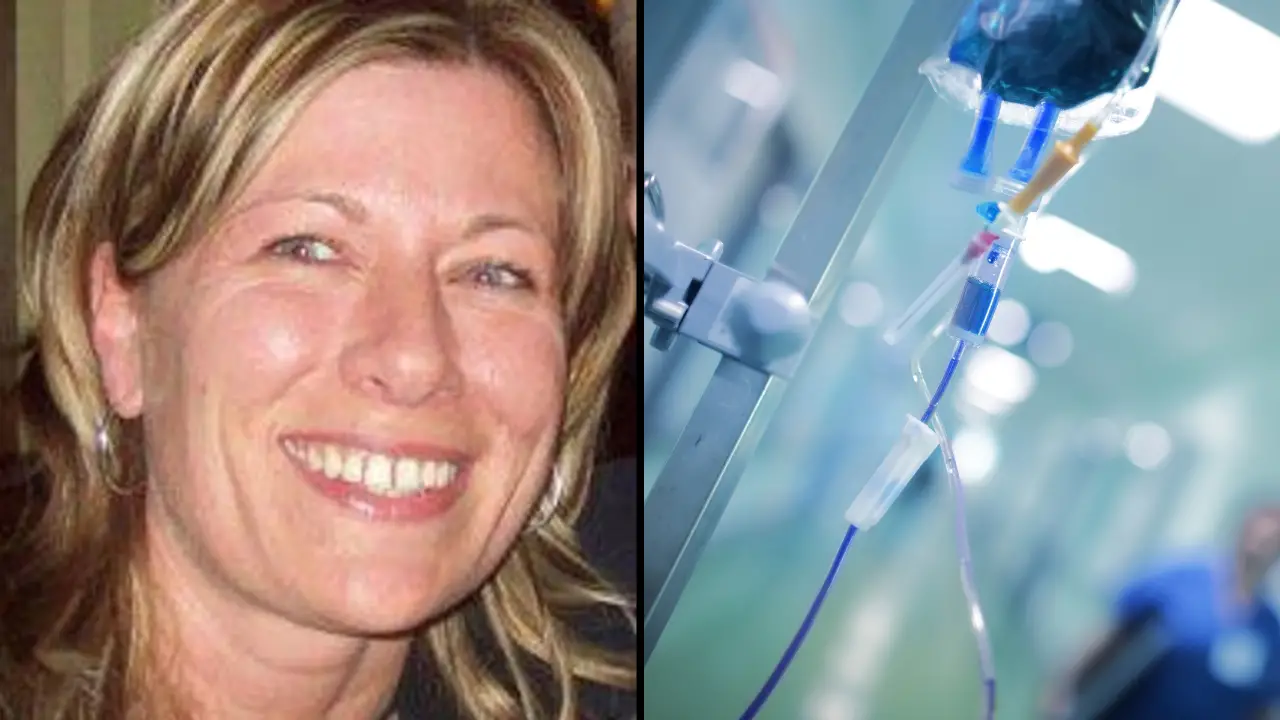
Credit: Facebook & Adobe Stock
Healthy Woman, 56, Explains Decision To Die By Euthanasia
A healthy woman aged 56 has explained her heartbreaking decision to die by euthanasia.
Few subjects provoke more heated debate in public life than assisted dying.
The question of whether a person should have the legal right to end their own life — and whether doctors or clinics should be permitted to help them do so — has been argued in Parliament, in courtrooms, in hospitals, and in homes across the country for decades.
This week, that debate has been brought into sharp and painful focus by the story of one woman from the West Midlands, who has made a decision that is entirely legal in Switzerland and entirely illegal in the United Kingdom.
What the law currently says
In England and Wales, euthanasia is a criminal offence carrying a maximum penalty of life imprisonment, per France 24.
Assisted suicide — helping another person to take their own life — carries a maximum sentence of fourteen years.
The only exception in UK law is so-called passive euthanasia, in which life-sustaining treatment is withdrawn from a patient who cannot survive without it, such as switching off a life support machine.
Terminally ill patients who are mentally capable have the right to refuse treatment, but active assistance in dying remains a crime.
As a result, British citizens who wish to pursue a legally assisted death must travel abroad.
Switzerland, uniquely, permits assisted dying not only for its own citizens but for foreign nationals, provided certain conditions are met, the Sun reports.
The Pegasos clinic, a non-profit organisation operating under Swiss law, is one of a small number of facilities offering what it calls voluntary assisted dying.
Under Swiss law, it is illegal for Pegasos to profit from the procedure, though clients pay for their own medication, doctors, and funeral costs, with a portion going to the Swiss state.
Pegasos does not administer the lethal drugs itself — under Swiss law, the person must turn the dial themselves.
The broader debate in the UK has intensified in recent months.
A Terminally Ill Adults (End of Life) Bill — which would allow adults in England and Wales with a terminal diagnosis and less than six months to live to apply for an assisted death, subject to approval from two doctors and an expert panel — has been making its way through Parliament. It has passed through the Commons but has become stuck in the House of Lords, and is now expected to run out of parliamentary time before the session ends ahead of the King’s Speech in May.
Supporters believe it could be revived in the next session. Critics argue it does not go far enough in its safeguards — or goes far too far.
The safeguards that remain in the bill are substantial. Two doctors must independently assess the patient, at least seven days apart. There is a mandatory fourteen-day reflection period. The patient must demonstrate mental capacity, freedom from coercion, and must make two separate witnessed and signed declarations.
Only those over 18, registered with a GP in England or Wales for at least twelve months, and confirmed terminally ill with a life expectancy of under six months are eligible.
Crucially, the bill does not cover people without a terminal illness. Which is precisely why the case of Wendy Duffy has provoked such an intense response.
A case that divides
Alistair Thompson, spokesman for Care Not Killing — a campaign group opposed to the legalisation of assisted dying in the UK — has spoken directly about Wendy’s case, describing it as highlighting ‘the real dangers of legalising assisted suicide and euthanasia.’
He argued that the existence of cases like hers in Switzerland demonstrates why no safe system can exist.
“Once you legalise assisted killing, it is only a matter of who is eligible, when they are eligible,” he said, per Birmingham Mail. “You end up with tragic and heartbreaking cases like this.”
Labour MP Rachel Maskell took a different view but was similarly cautious about the path Wendy had taken.
“Complex grief needs to be far better understood and supported,” she said. “Nothing could be more tragic than losing your own child in unexpected circumstances, but Wendy’s story highlights why far more needs to be invested into trauma management. The answer is not ending your own life.”
She called on Parliament to explore ways of protecting people from using facilities like Pegasos ‘at their most vulnerable state.’

The Irish Daily Mail, covering the case, asked on its front page: “Who is anyone to decide how much a human should endure?”
Its writer described Wendy as representing ‘the deepest fears of those who are against assisted suicide,’ while also acknowledging the ‘bone-deep sadness’ of her circumstances.
The conservative American magazine National Review was more categorical in its criticism, accusing the Pegasos clinic of ‘promoting a death-on-demand culture.’
Who is Wendy Duffy?
Wendy Duffy is 56 years old, physically healthy, and of sound mind. She is a former care worker from the West Midlands who spent her professional life looking after others.
She has four sisters and two brothers. She struggled with infertility for years. She has been through extensive therapy and was prescribed antidepressants.
She has attempted to end her own life before — and she has spent the past year going through a rigorous application process with the Pegasos clinic, which includes forms, interviews, and assessment by a panel of psychiatrists and other experts with full access to her medical history.
That panel approved her application. She has paid £10,000 — her life savings — to proceed.
She has written letters to her family. She has cleared out her home. She has picked what she is going to wear. She has chosen the music that will be playing when she dies — and she has asked that the windows in the room be kept open, so that, as she put it, her spirit can be free.
Her ashes are to be sent back to her family and scattered at a bench in a park — alongside the ashes of the person whose death made her feel that her own life had already ended.
Why Wendy made this choice
Wendy Duffy had one child. His name was Marcus. He was 23 years old and an aspiring musician when he died in 2022.
He had been out the night before and came home hungover. His mother was making herself a sandwich — cheese and onion — and Marcus asked for one too. He asked her to throw a couple of cherry tomatoes on his.
She left the room. When she came back, he was unconscious on the sofa. Half a cherry tomato had lodged in his windpipe. He was deprived of oxygen to his brain.
His mother performed CPR on him herself. Paramedics arrived and continued trying to save him. He was taken to the hospital. Wendy sat with him for five days. And then he died.
In the days after his death, she went to the funeral home every day and sat with him, playing through his Spotify playlist. “I broke when I saw him in there,” she said. “My boy, on a metal table. You can’t come back from that, you know.”
She described the moment she understood the depth of what had happened to her: “That’s when I died too, inside. I’m not the same person now as I was. I used to feel things. I’d go to funerals after Marcus died, and I’d feel nothing.
“It’s why I had to give up work. You can’t be a carer if you don’t care, and I’m sorry, but I don’t. I don’t care about anything any more. I exist. I don’t live.”
Nine months after Marcus died, she attempted to take her own life. A friend raised the alarm when she stopped responding to messages. Police broke into her home. She was placed on a ventilator for two weeks. She was moved to a psychiatric ward and discharged herself after one night.
She received counselling on the NHS and privately. She was on antidepressants. She says none of it helped.
When she travels to Switzerland, she will be wearing a t-shirt that belonged to her son. She says it still smells like him.
“My life, my choice,” she said simply. “I want to die, and that’s what I’m going to do.”
If you are struggling, help is available. In the UK, the Samaritans are available 24 hours a day on 116 123, or visit samaritans.org. CALM can be reached at 0800 585 858 or thecalmzone.net.
Related Article: Man Who Died And ‘Went To Heaven’ Shares The Three Big Lessons He Learned In Afterlife
Related Article: Parents Share Heartbreaking Reason They Supported 33-Year-Old Daughter’s Decision To Be Euthanized
Want more stuff like this?
Get the best viral stories straight into your inbox!
