
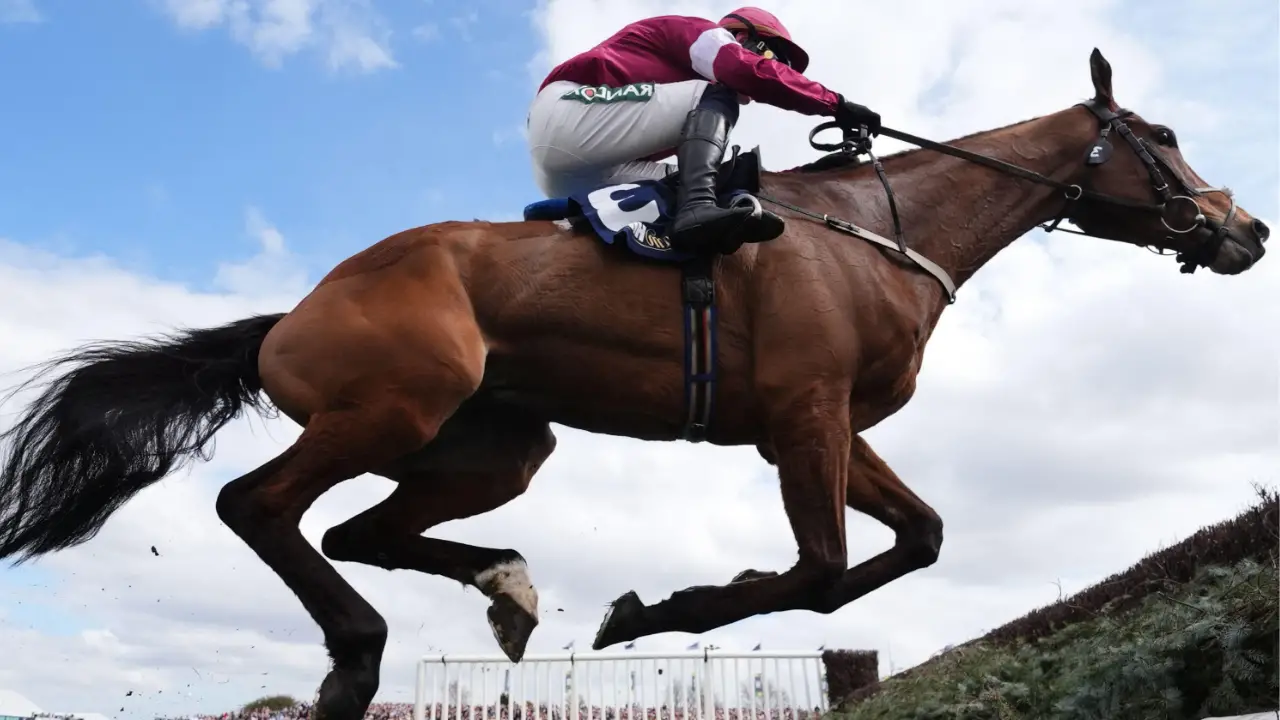
Credit: Alamy
Why Jockey Won’t Be Punished After Forcing Injured Horse To Finish Race Before It Died
There’s a shocking reason why the jockey who forced his injured horse to finish a race before it died won’t be punished.
It was meant to be a moment of triumph — a dominant performance at one of British racing’s most prestigious meetings.
Instead, the 2026 Grand National Festival became the centre of a deeply unsettling controversy after a horse suffered a catastrophic injury and died moments after crossing the finish line.
The horse, Gold Dancer, had looked all but certain to secure a major victory. But what followed has sparked outrage, grief, and a fierce debate about the realities of professional horse racing.
A race that turned from victory to tragedy
Gold Dancer, a seven-year-old trained by leading Irish trainer Willie Mullins, had delivered an exceptional performance in the William Hill Mildmay Novices’ Chase at Aintree.
Owned by Gigginstown House Stud, the powerful operation linked to businessman Michael O’Leary, the horse appeared in complete control throughout the race. His jumping was described as near flawless, and by the time he approached the final fence, the result seemed almost inevitable.
Then came the moment that changed everything.
At the last obstacle, Gold Dancer made a mistake — clipping the fence and landing awkwardly. For a split second, it looked as though his jockey, Paul Townend, might be thrown.
He wasn’t. Regaining balance quickly, Townend pushed the horse forward. Gold Dancer continued running, crossed the finish line in first place, and secured a comfortable victory.
But within moments, the scene shifted dramatically.
Townend pulled the horse up shortly after the line. Veterinary staff rushed in, and green screens were erected around the animal — a familiar but distressing sight at major race meetings.
The diagnosis soon followed: Gold Dancer had suffered a broken back at the final fence. He was euthanised on the track.
The question everyone asked
Almost immediately, one question dominated public reaction: why was the horse ridden to the finish at all?
Footage showed Gold Dancer being urged forward — even struck with the whip — after the final fence error. To many watching, it appeared as though the horse had been forced to continue despite being seriously injured.
The idea that the horse may have run the final stretch in pain struck a nerve, triggering widespread criticism online and beyond.
For critics, it seemed unthinkable that such an injury could go unnoticed. For supporters within racing, the situation was more complex.
A formal stewards’ inquiry was launched as standard procedure following any fatal incident.
What the jockey said happened
Rather than speaking publicly, Paul Townend gave his account directly to race stewards.
According to the official report, he explained that after the mistake at the final fence, Gold Dancer quickly regained rhythm and continued running in a straight, balanced manner.
Crucially, Townend said the horse “felt sound” beneath him.
There were no obvious signs — no limping, no deviation, no imbalance — that would have indicated a catastrophic injury in those final moments before the finish line.
It was only after crossing the line, when the horse began to slow and turn toward the pull-up area, that something changed.
The horse’s movement shifted from a smooth canter to a more uneven trot. At that point, Townend immediately realised something was wrong, pulled up, and dismounted so veterinary teams could intervene.
The expert view that shaped the outcome
The key figure in the inquiry was James Given, Director of Equine Regulation, Safety and Welfare at the British Horseracing Authority.
After reviewing footage from multiple angles, Given supported Townend’s account.
He stated that Gold Dancer’s movement immediately after the final fence appeared typical of a horse in the closing stages of a race. The horse ran straight and showed no visible asymmetry — a critical indicator experts look for when identifying injury.
“The horse felt normal to him,” Given explained. “He ran straight as an arrow to the line.”
He emphasised that the only noticeable change occurred after the finish, when the horse’s gait altered during the turn — precisely the moment Townend reacted.
Given concluded that there was no point during the race itself where the jockey could reasonably have been expected to detect the injury.
A sport under growing scrutiny
Despite the inquiry’s findings, the incident has intensified ongoing concerns about horse welfare in racing.
The Grand National Festival has long been a focal point for criticism from animal welfare groups, and Gold Dancer’s death has added to those concerns.
Statistics show dozens of horse fatalities linked to racing each year in the UK, with incidents at major festivals drawing the most attention.
Organisations such as the RSPCA and the League Against Cruel Sports have renewed calls for reform, arguing that tragedies like this highlight the risks horses face for sport and entertainment.
Some campaigners have gone further, urging boycotts of high-profile racing events and demanding stricter safety measures.
Within the sport, however, there is a different perspective.
Trainer Willie Mullins defended his jockey, explaining that riders must rely entirely on what they feel in the moment — not what might later be visible on replay.
He compared the situation to a footballer continuing toward goal: unless something clearly feels wrong, the instinct is to continue.
Owners of the horse echoed this view, describing the incident as a heartbreaking accident rather than a failure of judgment.
Why no punishment was given
In the end, the stewards reached a clear conclusion.
After reviewing all evidence — including video footage, veterinary input, and Townend’s testimony — they determined that the jockey had acted appropriately based on what he could reasonably perceive at the time.
Because Gold Dancer showed no obvious signs of injury until after the finish line, officials concluded that Townend had no way of knowing the severity of the situation during the race itself.
Under racing rules, jockeys are judged on what they can detect in real time — not what becomes apparent in hindsight.
As a result, no sanction, suspension, or punishment was issued.
While that decision has been accepted within the sport, it has done little to quiet the broader debate — one that continues to question not just this incident, but the ethics of horse racing as a whole.
Related Article: Zookeepers Finally Solve Mystery Of Female Monkey Who Got Pregnant While Alone In Her Cage
Related Article: Mom Explains Why She Doesn’t Regret Giving Her Daughter’s Pony To Zoo To Become Lion Food
Want more stuff like this?
Get the best viral stories straight into your inbox!
