
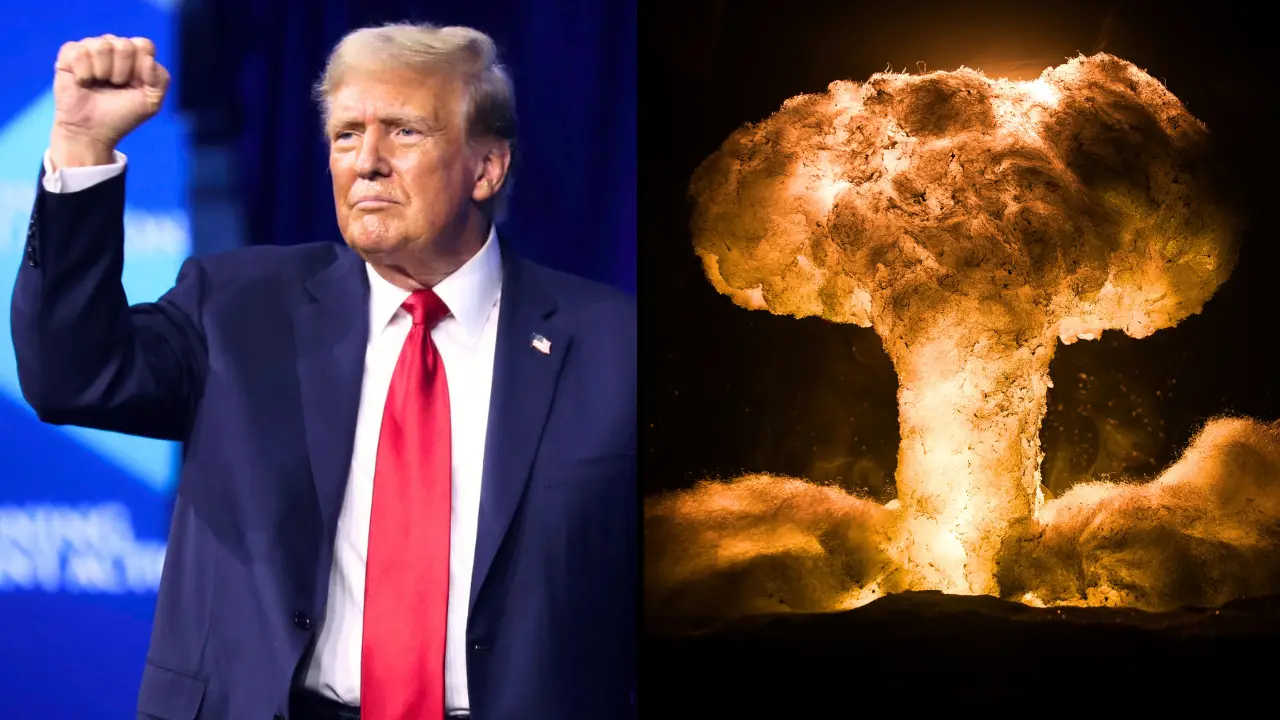
Credit: Alamy & Adobe Stock
Trump Says ‘A Whole Civilization Will Die Tonight’ In Chilling Ultimatum
World tensions escalated dramatically after Donald Trump issued a stark and controversial warning: ‘a whole civilization will die tonight.’
The statement, posted on his Truth Social platform, has sent shockwaves across the international community, raising fears of a catastrophic escalation in an already volatile conflict involving Iran, Israel, and key global allies.
At the center of the crisis is the Strait of Hormuz, a narrow but crucial waterway responsible for transporting roughly 20% of the world’s oil and gas.
Iran’s control and partial closure of the strait in response to earlier military actions have disrupted global energy markets and heightened geopolitical tensions.
Trump has demanded that Iran reopen the route by a strict deadline, warning that failure to comply would result in severe military consequences.
Trump’s latest statement is part of a broader pattern of high-stakes rhetoric that has characterized his approach to foreign policy.
Throughout the conflict, he has issued multiple deadlines and threats, sometimes extending them at the last minute. However, his most recent comments suggest a willingness to follow through in a way that previous statements did not.
Critics argue that such language risks escalating tensions unnecessarily, while supporters contend that it demonstrates strength and resolve. Regardless of interpretation, the impact of these statements on global stability is undeniable.
A deadline with global consequences
Trump’s ultimatum included a deadline of 20:00 EDT, giving Iran mere hours to respond. In his message, he suggested that the stakes were nothing short of existential, writing that an entire civilization could be wiped out if diplomacy fails, per the BBC.
While he added that he did not want such an outcome, he also ominously stated that it was ‘likely’ to happen.
This rhetoric marks one of the most extreme warnings issued during the ongoing conflict. While Trump has previously used aggressive language in foreign policy disputes, analysts note that this particular statement stands out for its apocalyptic tone.
The suggestion that civilian infrastructure—including bridges and power plants—could be targeted has sparked serious concerns among legal experts and human rights organizations about potential violations of international law.
Military escalation already underway
Even before the deadline, military actions were intensifying. U.S. forces reportedly carried out strikes on Kharg Island, a strategic hub for Iran’s oil exports. Though officials stated that oil infrastructure itself was not directly targeted, the strikes sent a clear signal about the seriousness of U.S. intentions.
Meanwhile, Israeli forces have also expanded their operations, targeting transportation networks within Iran.
Reports indicate that railway lines and bridges have been hit, disrupting movement across several major cities including Tehran. Iranian state media confirmed casualties following at least one strike on a bridge in the city of Kashan, further fueling anger and fear among civilians.
In response, Iran has launched missile attacks toward Israeli territory and warned that any further escalation could lead to a broader regional conflict.
The country’s leadership has also made it clear that it will not easily concede to external pressure, framing the situation as a matter of national sovereignty and resistance.
Diplomatic efforts falter
Despite the looming threat of escalation, diplomatic talks between the United States and Iran appear to be stalled.
Previous deadlines set by Trump had been extended after negotiations showed some progress, but this time, the tone appears markedly different. Officials familiar with the discussions suggest that neither side is willing to compromise on key demands.
Iran has rejected recent proposals, insisting on a permanent end to hostilities rather than temporary ceasefires.
Meanwhile, the US has maintained that reopening the Strait of Hormuz is non-negotiable, given its importance to global trade and energy supply.
Vice President JD Vance, speaking from Budapest, reinforced the administration’s stance, stating that the US has ‘tools in our toolkit’ that have not yet been used.
He also claimed that American military objectives in the region have largely been achieved, placing the responsibility for further escalation squarely on Iran.

Concerns mount
As political leaders exchange threats, the human cost of the conflict continues to rise.
Reports from within Iran describe growing fear among civilians, many of whom are bracing for potential large-scale attacks.
Infrastructure damage has already disrupted daily life, with transportation systems halted and access to essential services becoming increasingly uncertain.
Warnings issued by the Israeli military advising Iranians to avoid trains ‘for the sake of your security’ have only heightened anxiety. For many, the possibility of widespread destruction is no longer hypothetical but an imminent reality.
Human rights organizations have raised alarms about the potential targeting of civilian infrastructure, which could have devastating consequences for millions of people. The prospect of power plants being destroyed, for example, raises concerns about access to electricity, healthcare, and clean water.
The international community has responded with a mixture of alarm and calls for restraint.
European leaders have urged both sides to return to negotiations, emphasizing the need to avoid a broader regional war. Meanwhile, global markets have reacted nervously, with oil prices surging amid fears of prolonged disruption in the Strait of Hormuz.
Countries heavily dependent on Middle Eastern oil, including several in Asia and Europe, are particularly vulnerable to the economic fallout.
Analysts warn that a sustained closure of the strait—or worse, a full-scale conflict—could trigger a global energy crisis with far-reaching consequences.
Related Article: Every Citizen Who Would Be Drafted If The US Went to War
Related Article: If Donald Trump Dies While In Office, This Is The First Thing You Will Hear
Want more stuff like this?
Get the best viral stories straight into your inbox!
