
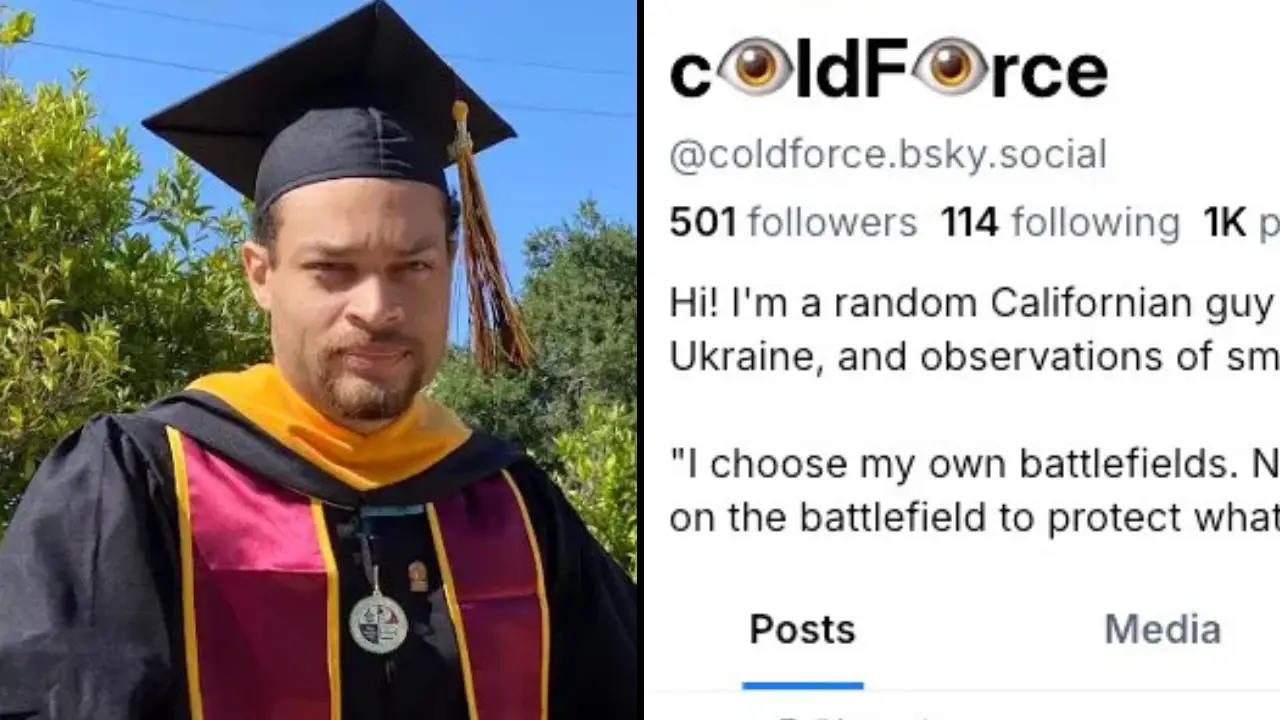
Credit: LinkedIn & BlueSky
Trump Shooting Suspect’s Chilling Final Posts Before Opening Fire At White House Dinner
The Trump shooting suspect shared some chilling final posts before he opened fire at the White House dinner.
In the immediate aftermath of the attempted shooting at the White House Correspondents’ Association dinner on April 25, 2026, two very different narratives began unfolding at once.
One was rooted in confirmed facts: a gunman breaching security at one of Washington’s most high-profile events, firing at law enforcement, and triggering the evacuation of President Donald Trump and other senior officials.
The other was something far less grounded, but no less widespread—a surge of conspiracy theories suggesting the entire incident had been staged.
Fueling that second narrative was a widely circulated clip of White House press secretary Karoline Leavitt, who, hours before the shooting, had used the phrase ‘shots fired’ during a red carpet interview. Stripped of context, the remark became the centerpiece of speculation across social media platforms.
But as the noise grew louder, investigators were uncovering something far more concrete and far more disturbing: the writings and final online posts of the man accused of carrying out the attack, Cole Tomas Allen.
What actually happened
Shortly after 8:30 p.m. Eastern Time, as the White House Correspondents’ dinner was underway at the Washington Hilton Hotel, a man rushed through a security checkpoint in the building’s foyer. He was armed with a shotgun, a handgun, and multiple knives.
According to officials, he encountered law enforcement almost immediately and opened fire.
A Secret Service agent was struck, though the bullet hit his protective vest, preventing serious injury.
Inside the ballroom, confusion and panic spread within seconds as attendees reacted to the sound of gunfire.
President Trump, the First Lady, Vice President JD Vance, and other senior figures were quickly moved out of the room by security personnel. Witnesses described diving under tables as agents secured the area and neutralized the threat.
The suspect, later identified as 31-year-old Cole Tomas Allen from Torrance, California, was tackled to the ground and taken into custody. He was transported to hospital for evaluation and has not cooperated with investigators.
A document recovered from his hotel room provided immediate insight into his intentions. In it, Allen referred to himself as the ‘Friendly Federal Assassin’ and outlined a list of targets that included members of the Trump administration. Officials later confirmed that Trump was considered a likely intended target.
The conspiracy theories that took over
While authorities worked to establish the facts, a parallel narrative began spreading across platforms like X, Instagram, and Reddit.
Central to these claims was the clip of Karoline Leavitt, who had told an interviewer before the event: “There will be some shots fired tonight in the room.”
In isolation, the phrase appeared ominous. But in context, it was a routine figure of speech referring to comedic jabs, a longstanding tradition of correspondents’ dinners where presidents deliver roast-style speeches.
Leavitt’s comment came during a lighthearted exchange about Trump’s planned remarks, and Trump himself later confirmed he had prepared a series of aggressive jokes before abandoning them in light of the shooting.
Other claims followed quickly. Some users suggested that the camera angles capturing Trump’s evacuation were suspiciously well-positioned.
Others pointed to unverified reports about the suspect’s clothing or attempted to link his name to unrelated posts from years earlier.
A brief interruption during a live television call was interpreted as a deliberate attempt to silence a reporter, despite being immediately explained as a technical issue.
One of the more unusual claims involved a performer onstage at the time of the shooting, with speculation that he had been signaling the attack. In reality, he was a mentalist in the middle of a routine, later explaining in detail what had occurred.
Despite the volume of speculation, none of these claims has been supported by credible evidence.
The only aspect of the incident that has raised legitimate questions is how the suspect was able to access the building with multiple weapons, a concern that officials have acknowledged as a serious security failure.

Who is Cole Tomas Allen?
As investigators began to piece together Allen’s background, what emerged was a profile that many found difficult to reconcile with the violence of the act.
He was highly educated, having graduated from the California Institute of Technology with a degree in mechanical engineering before completing a master’s in computer science.
He worked as a teacher and tutor, and those who knew him described him as polite, intelligent, and reserved.
He lived with his family in a quiet California suburb. Neighbors described the household as friendly and unremarkable. Students who had worked with him said he appeared normal and approachable.
Yet beneath that outward stability, there were signs of growing extremism. Family members later told investigators that Allen had been making increasingly radical statements and had spoken vaguely about wanting to take action to address what he saw as systemic problems in the world.
He trained regularly with firearms he had legally purchased, and his writings suggest a mindset that had become increasingly consumed by anger and moral urgency.
The manifesto and motive
The document found in Allen’s hotel room offers the clearest window into his thinking.
It began with a series of apologies to people in his life, acknowledging that his actions would betray their trust. From there, it transitioned into a justification of violence framed in both political and moral terms.
Allen wrote that he experienced overwhelming rage when thinking about the actions of the Trump administration.
He referenced a range of issues, including military actions and domestic policies, portraying them as evidence of systemic injustice.
His language repeatedly returned to the idea of complicity, arguing that failing to act against perceived wrongdoing was itself a moral failure. This framing allowed him to position his planned violence not as aggression, but as a form of intervention.
Officials confirmed that the manifesto outlined specific targets and reflected a consistent focus on members of the administration.
The chilling final posts before the attack
In the days leading up to the shooting, Allen’s online activity intensified noticeably, the New York Post reports.
Posting under the handle ‘Coldforce’ on BlueSky, he shared a stream of messages that revealed both his political views and his emotional state. Many of the posts were sharply critical of the Trump administration, often using harsh and inflammatory language.
He reacted angrily to policy decisions, particularly those related to foreign affairs. After comments by Vice President JD Vance about Ukraine, Allen posted insults directed at him and amplified fundraising efforts supporting Ukrainian causes.
He described Trump in deeply negative terms, at one point calling him ‘a sociopathic mob boss,’ and criticized what he viewed as moral and ethical failures within the administration.
His posts increasingly incorporated religious themes. Identifying as a Protestant Christian, Allen argued that the administration’s actions were incompatible with genuine faith.
In one repost, he suggested that those working within the administration were spiritually compromised, writing that they must understand “at some level… that you are f***ing damned.”
In another post, he challenged traditional interpretations of forgiveness, arguing that extending grace in situations involving harm to others amounted to complicity. He wrote that ‘turning the other cheek when someone else is oppressed is not Christian behavior,’ a sentiment that closely echoed passages in his manifesto.
These posts reveal a pattern of thought that blends political anger with moral absolutism, creating a framework in which violence could be justified.
His final pinned post before deleting his account showed an animated image of a character kneeling and apologizing. The imagery mirrored the opening of his manifesto, reinforcing the sense that he viewed his actions as both necessary and regrettable.
Taken together, his posts and writings form a coherent narrative of escalating grievance and self-justification, offering a stark insight into the mindset that preceded the attack.
Related Article: Disturbing Theory About Trump’s Health Emerges As President ‘Locked Out Of Situation Room’
Related Article: Trump’s Allies Demand He’s Removed As President Under Rule That’s Never Been Used Before
Want more stuff like this?
Get the best viral stories straight into your inbox!
