
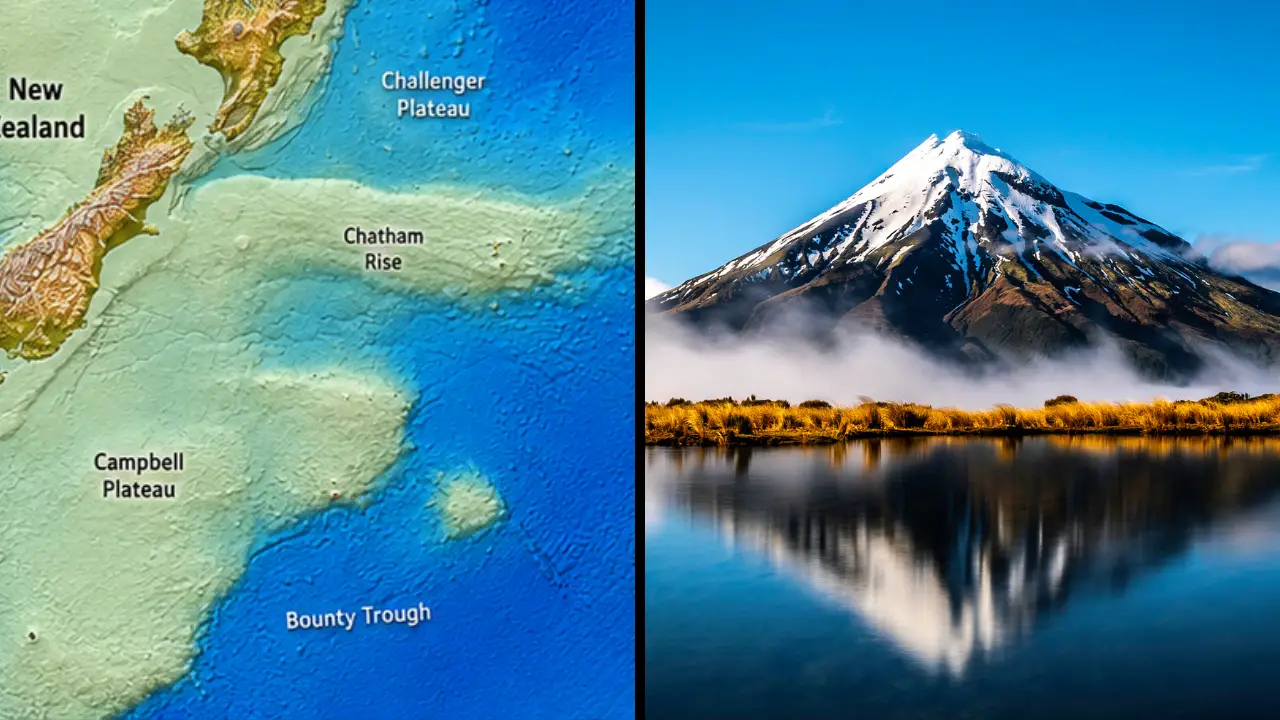
Credit: GNS Science/Adobe Stock
Scientists Discover Missing Continent After 375 Years
Scientists say they’ve finally identified a long-lost continent that remained hidden beneath the ocean for millions of years.
For generations, the world has been divided into seven recognized continents: Africa, Antarctica, Asia, Europe, North America, South America, and Australia.
Together, these vast landmasses have shaped Earth’s ecosystems, geography, and human history. But researchers now say there is another continent that deserves a place on that list.
Dubbed the ‘real-life Atlantis’, Zealandia or Te Riu-a-Māui, is a largely submerged landmass that has been officially recognized by geologists after centuries of speculation and exploration.
A search that began centuries ago
The story dates back to 1642, when Dutch explorer Abel Tasman set sail in search of Terra Australis, a hypothetical southern continent that many Europeans believed existed, BBC reports.
Leaving from Jakarta, Indonesia, Tasman’s journey eventually brought him to New Zealand’s South Island.
Before he could land, however, he encountered local Māori communities who resisted his arrival. According to historical accounts, efforts were made to prevent his approach and disrupt communication with his fleet.
Although Tasman returned home without finding the continent he sought, he unknowingly became the first European to document part of what scientists now recognize as Zealandia.
The continent hidden beneath the waves
Nearly four centuries later, researchers from GNS Science have helped confirm the existence of Zealandia, a continent covering roughly 1.89 million square miles (4.9 million square kilometers).
What makes Zealandia unique is that the overwhelming majority of it lies underwater.
Scientists believe the continent was once connected to the ancient supercontinent Gondwana alongside parts of Antarctica and Australia more than 500 million years ago.
Around 105 million years ago, Zealandia began breaking away from Gondwana in a complex geological process that researchers continue to investigate today.
You might be wondering why, if the majority of it is covered in water, Zealandia is classified as a continent, but it all comes down to several key criteria.
The main reason is that Zealandia has a distinct geological composition, comprising of a crust which is elevated compared to the surrounding ocean floor, clearly defined boundaries.
It is also a large enough area to be considered separate from neighboring continents.
New Zealand and New Caledonia are among the few visible portions of the continent, making it difficult for earlier generations of scientists to appreciate its true scale.
Advances in satellite mapping, ocean-floor surveys, and geological sampling ultimately allowed researchers to piece together a clearer picture of the submerged landmass.
How Zealandia disappeared
Andy Tulloch, a geologist at the New Zealand Crown Research Institute GNS Science and a key contributor to the 2017 research, explained what happened as the continent drifted apart.
He said: “Zealandia started to be pulled away from Gondwana,” eventually sinking beneath the waves.
Today, approximately 94 percent of the continent remains submerged, with much of its continental crust sitting nearly 6,560 feet (2 kilometers) below the ocean’s surface.
Its hidden nature is one of the main reasons it escaped recognition for so long despite its enormous size.
A discovery changing our understanding of Earth
The recognition of Zealandia highlights how major geological features can remain overlooked even in the modern scientific era.
Reflecting on the discovery, Tulloch said: “This is an example of how something very obvious can take a while to uncover.”
Nick Mortimer, who led the research team, pointed to another unusual feature of the continent.
He remarked: “Every continent on the planet has different countries on it, [but] there are only three territories on Zealandia.”
The identification of Zealandia serves as a reminder that many of Earth’s secrets remain hidden beneath the surface. For scientists, the continent offers a unique opportunity to better understand the planet’s geological history and the forces that continue to shape it today.
It’s hoped the discovery could help answer important questions about plate tectonics, continental formation, and mass geological changes that shaped the modern world.
Because much of the continent has remained relatively untouched beneath the ocean, it offers a unique record of Earth’s history stretching back hundreds of millions of years.
Related Article: Experts Issue Urgent Warning Over Super El Niño That Could Be The Strongest In History
Related Article: NASA Explains Why You Can Sometimes See The Moon During The Day
Want more stuff like this?
Get the best viral stories straight into your inbox!
