
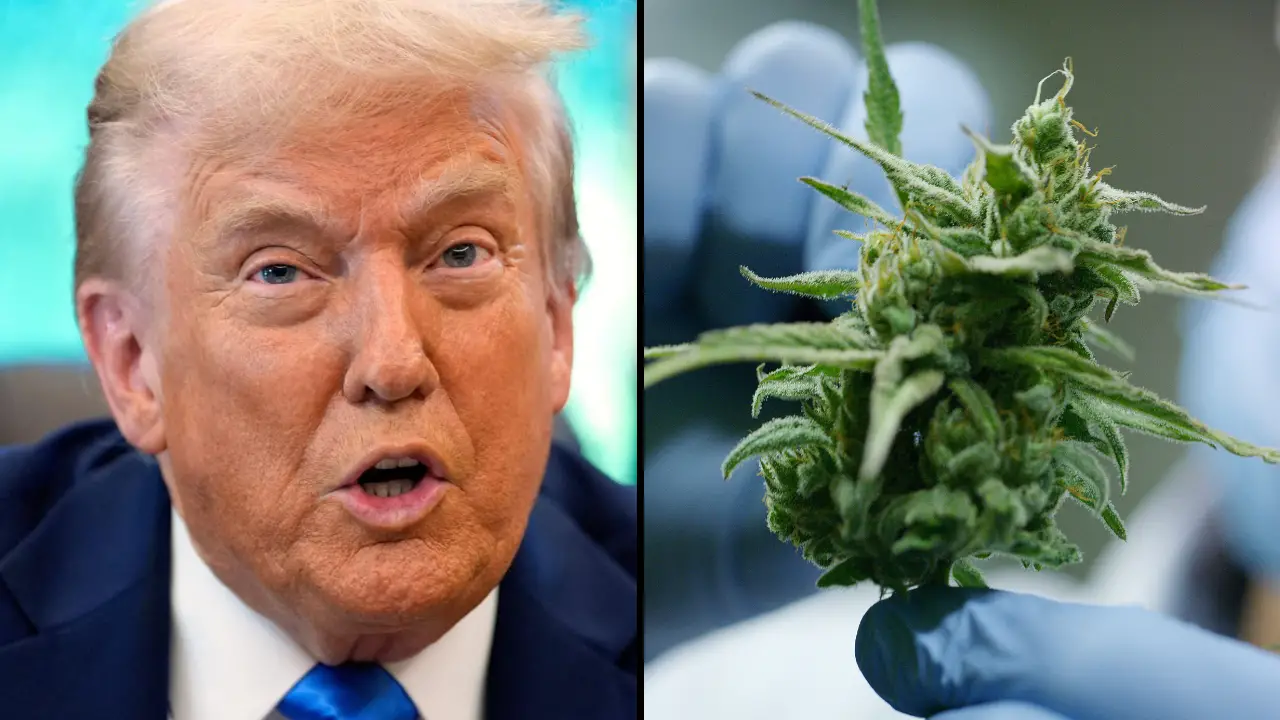
Credit: Alamy & Adobe Stock
Heart Surgeon Shares Terrifying Reality Of Smoking Weed As Trump Reclassifies Marijuana
A heart surgeon has shared what happens to your body when smoking weed as Trump reclassifies marijuana.
The United States has taken a significant step in reshaping its long-standing approach to cannabis, as the Trump administration moves to reclassify marijuana as a less dangerous drug.
The decision marks one of the most consequential federal policy shifts on cannabis in decades — but it also arrives amid growing debate about what the change really means for public health, per the BBC.
Under the new directive from Acting Attorney General Todd Blanche, certain marijuana products — particularly those approved by the Food and Drug Administration or licensed under state medical programmes — will move from Schedule I to Schedule III under the Controlled Substances Act.
That places them alongside substances like Tylenol with codeine, rather than drugs such as heroin or LSD, which remain in the most restrictive category.
The move, ordered by President Donald Trump as part of a broader push to expand access to medical treatments and research, is being framed by officials as a pragmatic adjustment rather than outright legalisation.
“This rescheduling action allows for research on the safety and efficacy of this substance, ultimately providing patients with better care and doctors with more reliable information,” Blanche said in a statement per the Guardian.
Yet while the policy shift is historic, it is also limited in scope — and, according to critics and experts alike, potentially misunderstood.
A major policy shift
Despite the headline-grabbing nature of the announcement, marijuana remains illegal at the federal level. The reclassification does not legalise recreational use, nor does it automatically free those incarcerated for cannabis-related offences.
Instead, the change primarily affects how the drug is regulated, studied, and taxed.
Moving cannabis to Schedule III reduces barriers to scientific research and allows licensed businesses to claim federal tax deductions — something previously prohibited under stricter classifications, the Independent reports.
It also acknowledges a reality that has been unfolding for years: cannabis is already widely used across the United States.
Today, most US states have legalised marijuana in some form, whether for medical or recreational purposes.
This has created a patchwork system where state laws often conflict with federal rules — complicating everything from banking access to interstate commerce.
For many advocates, the shift is long overdue.
“Moving it out of that classification allows us to have policy conversations that don’t start and end with that definition,” said Morgan Fox of the National Organization for the Reform of Marijuana Laws (NORML). “Lots of policymakers continue to fall back on that.”
However, Fox and others stress that rescheduling is only a partial fix.
“The real solution… is to de-schedule cannabis at the federal level, not just move to Schedule III,” he added.
Politics, public opinion and pressure
The timing of the move is no coincidence.
Public support for cannabis reform has steadily grown, with more than two-thirds of Americans backing full legalisation, according to advocacy groups.
Even among traditionally conservative voters, attitudes have softened, making marijuana policy a politically relevant issue — particularly among younger and libertarian-leaning demographics.
President Trump has openly pushed for faster action on the issue, reportedly expressing frustration at delays within federal agencies.
“You’re going to get the rescheduling done, right?” he said during a recent exchange with officials. “You know, they’re slow-walking me on rescheduling.”
The administration has also tied cannabis reform to a broader strategy of expanding access to alternative treatments, including recent efforts to accelerate research into psychedelic drugs.
Still, some analysts describe the current reclassification as largely symbolic — at least in the short term.
It opens doors for research and regulatory reform, but it does not immediately transform the legal landscape for users or businesses.

The science question
One of the central arguments behind reclassification is the need for better scientific understanding of cannabis.
For decades, its Schedule I status severely limited researchers’ ability to study its effects — both positive and negative. As a result, policymakers have often had to rely on incomplete or outdated data.
Now, with fewer restrictions, scientists may be able to conduct more rigorous investigations into cannabis’s medical potential — as well as its risks.
That’s particularly important as cannabis products become stronger and more widely available. In many states, high-potency strains and concentrated forms of THC are now commonplace, raising new questions about long-term health impacts.
While marijuana is often perceived as safer than other substances, emerging research suggests the picture may be more complicated.
Some studies have linked heavy cannabis use to mental health issues, dependency risks, and a condition known as cannabinoid hyperemesis syndrome — sometimes referred to as “scromiting,” which causes severe and prolonged vomiting.
But perhaps the most concerning findings are beginning to emerge in an area that receives far less public attention: cardiovascular health.
A heart surgeon’s warning
While policy debates focus on legality and access, some medical professionals are sounding a stark warning about what cannabis may be doing inside the body, particularly when smoked.
Dr Jeremy London, a cardiovascular surgeon with more than 25 years of experience, has become increasingly vocal about what he describes as a dangerous misconception surrounding marijuana use.
“Let’s all agree on one thing,” he said. “The lungs have one simple function, and that’s to bring air into and out of your lungs. Anything else is potentially harmful.”
According to Dr London, the idea that cannabis is ‘natural’ — and therefore safe — has led many patients to underestimate its risks.
“Here’s the truth,” he explained. “Smoking marijuana regularly increases your risk of coronary disease and acute heart attack by one point three to two times those that don’t smoke marijuana regularly.”
That level of increased risk, he noted, is comparable to well-known factors such as high blood pressure or elevated cholesterol.
But it’s not just statistics that concern him — it’s what he has seen firsthand in the operating room.
“I have operated on multiple patients over the years that smoke marijuana regularly and I can tell you their lungs are totally blackened,” he said. “It looks like they’ve worked in a coal mine.”
Even more striking, he added, is that many of these patients had never smoked cigarettes.
“They’ve got such severe blockages that I have to do bypass surgery,” Dr London said. “And these are folks that have never smoked a cigarette in their lives.”
What surprises him most is the consistency of one response. “They all say the same thing: ‘I thought it was safe.’”
A complex reality
As the US government moves to soften its stance on cannabis, the conversation around the drug is evolving rapidly.
For some, reclassification represents progress — a long-overdue recognition that marijuana has medical value and should be studied more thoroughly.
For others, it raises concerns that the risks of cannabis use may be underestimated, particularly as public perception shifts toward viewing it as harmless.
The truth likely lies somewhere in between.
The policy change may open doors for better research, clearer regulation, and improved patient care. But it also underscores the need for a more nuanced understanding of cannabis — one that goes beyond simple labels of “dangerous” or “safe.”
As Dr London puts it, the goal is not to dictate behaviour, but to ensure people are informed. “What’s important to me,” he said, “is that you know the inherent risk.”
Related Article: Weed Smokers Warned About Horrific ‘Scromiting’ Side Effect That Has Big Impact On Your Body
Related Article: Bill Filed To Invoke One Rule That Could Remove Trump As US President
Want more stuff like this?
Get the best viral stories straight into your inbox!
