
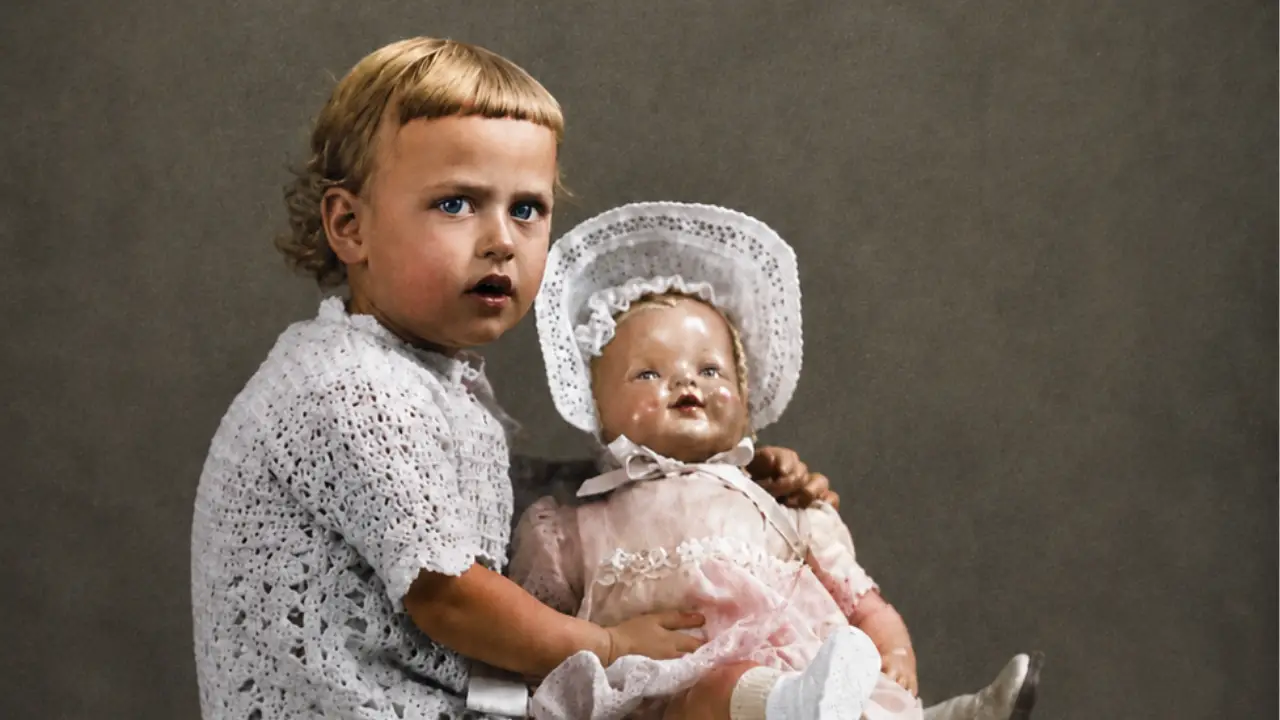
Credit: Handout
This Little Girl Grew Up To Be One Of The Most Evil Woman In The World
It’s hard to imagine, but the young girl pictured here would eventually become one of the most notorious serial killers in modern history.
At first glance, she appeared no different from countless other children growing up in post-war Britain. Yet the acts of cruelty, violence, and suffering she would later be associated with are among the most disturbing crimes in British criminal history.
With the benefit of hindsight, this seemingly innocent childhood photograph takes on a far darker meaning when viewed alongside the horrific legacy the girl would leave behind.
An ordinary childhood with early family struggles
When criminologists and investigators examine the backgrounds of serial killers, childhood experiences are often scrutinized for signs of trauma, abuse, or neglect that may have shaped their future behavior.
In this case, however, the story is less straightforward.
Born on July 23, 1942, in Gorton, Manchester, the girl grew up in circumstances that, while difficult, were not especially unusual for the era. Her mother, Nellie, worked as a laborer, while her father, Bob, served as an aircraft fitter during World War II. As a result, he was absent during the early years of her life while contributing to Britain’s wartime efforts.
After returning home, Bob struggled with depression and developed a serious drinking problem. His alcoholism led to both verbal and physical abuse toward Nellie, prompting the family to send their daughter to live with her maternal grandmother, Ellen.
Although she continued to spend time with her parents and joined them for meals, she often left when arguments escalated into violence. Such arrangements were not uncommon in Manchester during the 1940s.
As she grew older, the girl developed a deep resentment toward her father. Nevertheless, she later acknowledged that he taught her how to defend herself and protect her younger sister, Maureen, from bullies.
A skilled boxer during the war, Bob passed some of his fighting techniques on to his daughters. Yet despite those lessons, his treatment of Nellie left a lasting impression. Years later, the girl would become infamous for displaying her own shocking capacity for violence.
A tragic loss and growing religious devotion
As a teenager, she formed a close friendship with a local boy named Michael. Their bond strengthened throughout the mid-to-late 1950s, and she later described herself as being ‘very protective’ of him.
In the summer of 1957, tragedy struck.
Michael invited her to go swimming at a nearby reservoir, but she declined because she already had plans. Later that same day, she learned that he had drowned following an accident at the reservoir.
Devastated by the loss and burdened by feelings of guilt, she turned to Catholicism for comfort. In 1958, just over a year after leaving secondary school, she received her First Holy Communion.
Like many teenagers of the period, she spent her free time dancing, going to the movies, and playing bingo. On the surface, she appeared to be living a typical life.
Yet beneath that ordinary exterior, there were signs of a darker side beginning to emerge, though no one could have predicted how extreme it would eventually become.
The relationship that changed everything
After leaving school, she worked a variety of jobs. During this period, some colleagues became suspicious after she allegedly claimed to have lost her pay packet and accepted money from co-workers to replace it, only to report another missing wage packet shortly afterward.
She also took judo lessons and earned a reputation for holding onto opponents longer than necessary before releasing her grip.
In 1958, on her seventeenth birthday, her boyfriend Ronnie Sinclair proposed marriage. Although she initially accepted, the engagement lasted only a few months before she ended it, reportedly believing he was too immature.
Soon afterward, another man entered her life, a man with whom she would become forever linked in one of Britain’s most infamous murder cases.
While applying for a typist position at a chemical distribution company in Gorton, she met Ian Brady.
The young woman was Myra Hindley.
Their relationship would become the foundation of a criminal partnership that horrified the nation and led to a series of murders that continue to shock people decades later.

How the Moors Murders shocked Britain
Although Hindley and Brady initially bonded over literature, including a shared appreciation for poets William Wordsworth and William Blake, their relationship was built on far more troubling foundations.
The pair viewed themselves as intellectually superior to those around them and distanced themselves from their working-class roots.
Brady immersed himself in nihilistic philosophy and the writings of the Marquis de Sade, whose controversial ideas centered on pursuing one’s desires regardless of the consequences.
Over time, Brady’s disturbing interests increasingly influenced their relationship. Hindley later claimed he subjected her to physical abuse and humiliation. He also attempted to persuade her to reject her religious beliefs while encouraging racist and antisemitic views.
Initially, the couple acquired firearms with plans to commit robberies. Eventually, however, they abandoned those ambitions and turned their attention to far more sinister acts.
One influential book Brady introduced to Hindley was Compulsion, a novel involving the abduction and murder of a child. Notably, one of its characters was named Myra.
On July 12, 1963, Brady told Hindley he wanted to commit the ‘perfect murder.’
Using a van borrowed from work, Hindley drove while Brady followed on a motorcycle, signaling potential victims with his headlight.
Their first intended target escaped because Hindley recognized the child as a neighbor of her mother’s. Later that day, however, 16-year-old Pauline Reade accepted a ride from Hindley while on her way to a dance.
Hindley persuaded Reade to accompany her onto Saddleworth Moor under the pretense of searching for a lost glove. Brady later joined them.
Approximately 30 minutes after leaving with Reade, Brady returned alone. When Hindley saw the teenager again, she had suffered catastrophic injuries, including severe wounds to her throat.
When Hindley asked Brady whether he had sexually assaulted Reade, he chillingly replied: “Of course I did.”
Over the following two years, Brady and Hindley murdered John Kilbride, Keith Bennett, Lesley Ann Downey, and Edward Evans. Some victims were lured to Saddleworth Moor, while others were taken to the couple’s home on Wardle Brook Avenue.
The crimes eventually unraveled after the murder of 17-year-old Edward Evans. On the night of the killing, Hindley’s brother-in-law, David Smith, was present in the house.
While waiting in the kitchen, Smith heard a scream before Hindley shouted: “Dave, help him.”
Entering the living room, Smith witnessed Brady attacking Evans before strangling him with electrical cord.
The following morning, shaken by what he had seen, Smith contacted police.
Officers later searched the property and discovered Evans’ body in a spare bedroom. Brady attempted to explain the killing by saying, “Eddie and I had a row and the situation got out of hand.”
Although Hindley was not immediately arrested, investigators soon became convinced she had played an active role in the crimes. On October 11, 1965, she was charged as an accessory to Evans’ murder.
A notebook found during a search of the house led police to connect the pair to other unsolved disappearances. Their investigation eventually took officers to Saddleworth Moor, where the remains of several victims were recovered.
Lesley Ann Downey’s body was found on October 16, followed days later by the remains of John Kilbride.
However, despite extensive searches spanning decades, Keith Bennett’s body has never been found.
Although Brady eventually confessed to the murders of both Bennett and Pauline Reade in 1985, Bennett remains the only known victim whose remains have not been recovered. Searches continued for years, including a major operation in 2022, while investigators still work to locate him.
His mother, Winnie Johnson, who died in 2012, repeatedly appealed to Hindley for information about her son’s whereabouts, but received no meaningful assistance.
Hindley spent the remainder of her life behind bars, serving time at several prisons, including HMP Cookham Wood, HMP Holloway, and HMP Durham.
She died in 2002 at the age of 60 after developing bronchial pneumonia. Brady remained incarcerated until his death in 2017.
For more than three decades, Hindley’s infamous bleached-blonde mugshot became one of the most recognizable images in British criminal history.
Even today, the crimes committed by Hindley and Brady continue to horrify the public and remain among the most shocking and disturbing cases ever seen in Britain.
Related Article: This Baby Grew Up To Be One Of The Most Evil Men In History
Related Article: This Little Boy Grew Up To Be One Of The Most Famous Actors In The World
Want more stuff like this?
Get the best viral stories straight into your inbox!
