
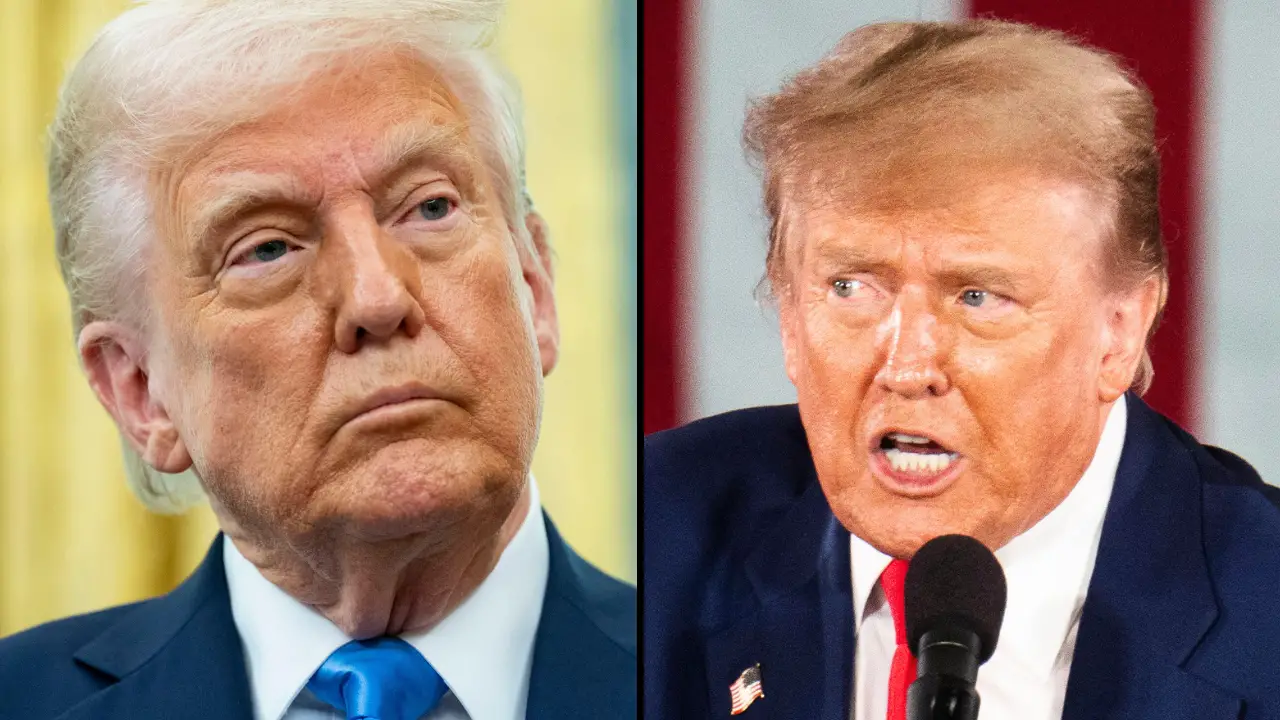
Credit: Alamy
What Will Happen If Trump Dies During His Presidency
As speculation surrounding Donald Trump’s health continues to make headlines, many people are wondering what would happen if he were to die while serving as president.
As the 79-year-old continues his second term in the White House, questions about the process of presidential succession have once again come into focus.
Given that Trump is currently the oldest individual ever elected president, understanding the constitutional procedures that would come into effect in the event of his death has become increasingly relevant.
Trump’s second White House term
Trump began his second term on January 20, 2025, after defeating Vice President Kamala Harris in the 2024 presidential election.
Upon returning to office, he pledged to tackle key issues including the economy, immigration, and America’s role on the world stage.
His second administration has been defined by a number of major policy initiatives and, much like his first term, intense political debate and controversy.
The administration has moved forward with large-scale deportation efforts and strengthened border security policies, measures that have sparked widespread protests and criticism in several cities.
Economically, Trump has continued to promote tariff-based policies while pursuing deregulation efforts. However, inflation and concerns over the rising cost of living remain major issues for voters.
On the international front, his administration has faced friction with longstanding NATO partners, revisited discussions involving Greenland, and responded to several global conflicts that have captured public attention, including recent events involving Iran.
How Americans view Trump’s presidency
Recent polling presents a mixed picture of public sentiment toward Trump’s performance in office.
Data compiled by polling analyst Nate Silver in mid-January 2026 showed Trump’s net approval rating at roughly -12.9, indicating that more Americans disapprove of his presidency than approve of it.
A Fox News survey conducted in late January 2026 found that Trump’s approval rating stood at 44%, unchanged from the previous month.
The same poll reported that 54% of voters believe the United States is in a worse position than it was one year earlier.
When it comes to the economy, only 37% of Americans approve of Trump’s handling of the issue, while 62% disapprove. That figure is especially significant given that economic improvement was one of the central promises of his campaign.
Meanwhile, a CNN poll released in early January found Trump’s overall approval rating at 39%, with majorities expressing dissatisfaction with his performance on issues including the economy, immigration, and foreign affairs.
According to the survey, 58% of Americans believe Trump has overstepped in his use of presidential authority.
Although Trump continues to enjoy strong backing among Republicans, with approval ratings near 85% among party members and overwhelming support from MAGA supporters, his approval among independent voters has fallen to just 29%. Those figures could create difficulties for Republicans ahead of the November 2026 midterm elections.

Could Trump serve a third term?
Under current constitutional rules, the answer is no. The 22nd Amendment clearly states: “No person shall be elected to the office of the President more than twice.”
The amendment was adopted in 1951 after Franklin D. Roosevelt served four terms as president.
Even so, Trump has occasionally suggested the possibility of serving beyond two elected terms.
Speaking to NBC News in March 2025, he said there were ‘methods’ through which he could potentially return to office, adding: “I’m not joking.”
Some observers have discussed hypothetical scenarios involving succession laws or constitutional changes, though such possibilities remain highly unlikely.
Shortly after Trump’s second inauguration, Tennessee Representative Andy Ogles introduced a resolution seeking to amend the Constitution in a way that would permit Trump to seek a third term. The proposal, however, has made little progress.
Changing the Constitution would require support from two-thirds of both chambers of Congress, followed by ratification from three-fourths of state legislatures, a threshold that is extremely difficult to achieve.
In 2025, House Speaker Mike Johnson stated that he saw no realistic route for such an amendment to succeed.
By October 2025, Trump himself appeared to acknowledge the constitutional limitation, saying, ‘it’s pretty clear I’m not allowed to run’ for another term, although he has continued to make occasional remarks about the idea.
What would happen if Trump died in office?
The process for replacing a president who dies in office is clearly outlined in the Constitution.
The 25th Amendment, ratified in 1967, states: “In case of the removal of the President from office or of his death or resignation, the Vice President shall become President.”
If Trump were to die while serving, Vice President JD Vance would immediately take over as president. He would be sworn in as soon as practicable and would complete the remainder of Trump’s term, which is scheduled to end on January 20, 2029.
As president, Vance would have the power to nominate a new vice president. That nominee would need to be approved by a majority vote in both the House of Representatives and the Senate. Vance would also have the option of retaining or replacing members of Trump’s cabinet.
Throughout US history, eight presidents have died while in office. Four died of natural causes, William Henry Harrison, Zachary Taylor, Warren G. Harding, and Franklin D. Roosevelt, while four were assassinated: Abraham Lincoln, James A. Garfield, William McKinley, and John F. Kennedy.
In every instance, the vice president assumed the presidency, ensuring continuity of government and preserving the constitutional system.
If Trump were to die before August 1, 2026, Vance would become the youngest president in American history at age 41, surpassing Theodore Roosevelt, who was 42 when he took office following McKinley’s assassination in 1901.
Because Vance would serve more than two years of Trump’s remaining term, the 22nd Amendment would allow him to seek election as president only once afterward. Had he served less than two years of the term, he would have been eligible to run twice.
There would be no special presidential election following Trump’s death. The normal election timetable would remain unchanged, with the next presidential election scheduled for November 2028 and the next inauguration taking place on January 20, 2029.
The succession plan extends beyond the vice president as well.
Under the Presidential Succession Act of 1947, if both the president and vice president were unable to serve, the Speaker of the House would be next in line, followed by the President Pro Tempore of the Senate and then cabinet secretaries in the order their departments were created.
Related Article: Donald Trump Threatens To Invoke Insurrection Act – Here’s What It Means
Related Article: Donald Trump’s Niece Makes Bombshell Claims About President’s Health
Want more stuff like this?
Get the best viral stories straight into your inbox!
