
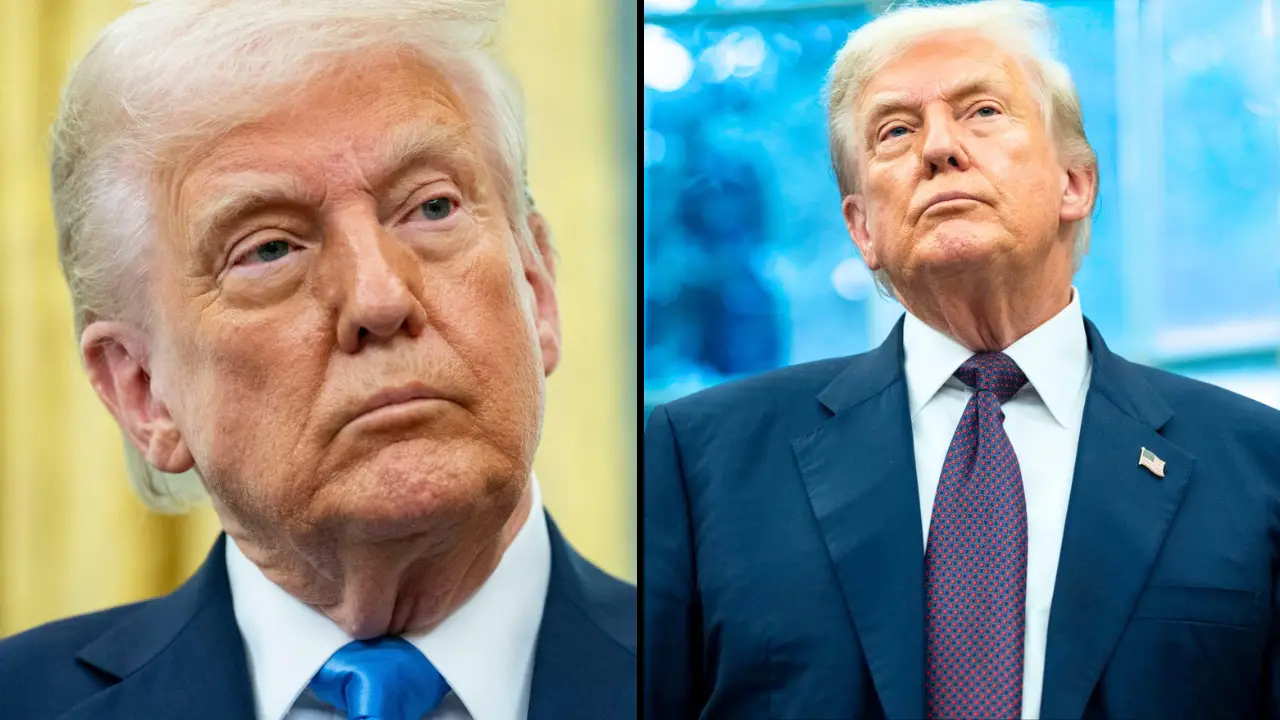
Credit: Alamy
Here’s What Would Happen If Trump Is Killed During Presidency
Here’s everything that would happen if Donald Trump were killed during his presidency.
The attempted shooting at the White House Correspondents’ Association dinner on April 25, 2026, has not only shocked Washington but also reignited a question many Americans rarely think about in real time: what would actually happen if a sitting president were killed in office?
The annual dinner, held at the Washington Hilton Hotel, is typically a carefully managed and highly secure event bringing together the president, senior government officials, journalists, and celebrities.
But that sense of control collapsed in seconds when a gunman stormed a security checkpoint just outside the ballroom, armed with a shotgun, a handgun, and multiple knives.
Shots were fired. A Secret Service agent was struck, though his bulletproof vest prevented serious injury. Inside the ballroom, panic spread rapidly. Attendees ducked under tables, glass shattered, and security personnel flooded the room.
President Donald Trump, First Lady Melania Trump, and Vice President JD Vance were all present on stage.
Vance was pulled away quickly by agents, while Trump was briefly shielded and then escorted out after a short delay, which he later attributed to his own hesitation. “I wanted to see what was happening,” he said afterward.
The suspect, identified as 31-year-old Cole Tomas Allen, was subdued and taken into custody. Investigators later recovered a manifesto outlining his motivations, confirming that members of the Trump administration were his intended targets and that Trump himself was considered a likely focus.
The incident has raised urgent questions about security failures, particularly given the concentration of leadership present in a single room. But it has also brought renewed attention to something even more fundamental: the constitutional process that governs what happens if the worst-case scenario ever becomes reality.
The constitutional rule is immediate and automatic
The United States has a clear and longstanding system for presidential succession, designed specifically to ensure stability during moments of crisis.
If a president dies in office, the transfer of power is immediate. There is no waiting period, no temporary arrangement, and no ambiguity.
The 25th Amendment to the Constitution states plainly that in the event of the president’s death, resignation, or removal, the vice president becomes president.
That means Vice President JD Vance would immediately assume the role of president. He would not serve as an acting president but would formally become president of the United States.
This transition would typically be accompanied by a swearing-in ceremony as soon as possible, often within hours, to ensure continuity of leadership.
This system has been tested multiple times throughout American history. Eight presidents have died in office, including four who were assassinated. In each case, the vice president took over without disrupting the constitutional order.
JD Vance would become president
If such an event were to occur today, JD Vance would be next in line.
At 41 years old, he would become one of the youngest presidents in American history, even younger than Theodore Roosevelt was when he assumed office in 1901 after the assassination of President William McKinley.
Vance would then serve out the remainder of Trump’s term, which is set to run until January 20, 2029.
He would gain all the powers of the presidency immediately, including authority over the military, foreign policy, and executive decision-making. There would be no limitations on his role compared to an elected president.
He would also have the authority to shape the direction of the administration moving forward, including making changes to personnel and policy if he chose to do so.
A new vice president would be chosen
Once Vance became president, the position of vice president would be vacant.
Under the 25th Amendment, the new president has the power to nominate a replacement vice president. That nominee must then be confirmed by a majority vote in both the House of Representatives and the Senate.
This process has been used before, most notably when Gerald Ford became president after Richard Nixon’s resignation and nominated Nelson Rockefeller as his vice president.
Until a new vice president is confirmed, the next individuals in the line of succession would move up in priority.
The line of succession continues beyond that
If, in an extreme scenario, both the president and vice president were unable to serve, the line of succession extends further.
Under the Presidential Succession Act of 1947, the Speaker of the House is next in line, followed by the President Pro Tempore of the Senate and then members of the cabinet in a specific order.
This structure ensures that there is always a designated individual ready to assume the presidency if necessary, even in the most catastrophic circumstances.
The events at the White House Correspondents’ dinner have highlighted why this system exists.
With the president, vice president, and speaker of the House all present in one location, lawmakers have pointed out the potential risks of such a concentration of leadership.
There would be no new election
One of the most common misconceptions about presidential succession is that a new election would be triggered if a president dies in office.
In reality, that does not happen.
The vice president who becomes president serves out the remainder of the term. The regular election cycle continues as scheduled, with the next presidential election taking place at its normal time.
In Trump’s case, that would mean the next election would still occur in November 2028, with the new term beginning in January 2029.
There is no provision in the Constitution for a special national election to replace a sitting president.
Term limits would still apply
Another important question is how this would affect future elections.
The 22nd Amendment limits presidents to two terms, but it also includes specific rules for those who assume office through succession.
If a vice president serves more than two years of a predecessor’s term, they can only be elected to the presidency once more. If they serve less than two years, they can potentially be elected twice.
In this scenario, because Trump’s term has only recently begun, Vance would serve more than two years if he took over now. That would mean he could run for president once in his own right.
Why this conversation is happening now
While discussions about presidential succession are typically theoretical, events like the attempted shooting bring them into sharp focus.
The incident at the Washington Hilton is being described by some as the third serious threat against Trump in less than two years, following earlier incidents in Pennsylvania and Florida.
It has also exposed vulnerabilities in security planning. Reports indicate that the event was not designated a National Special Security Event, despite the presence of multiple high-ranking officials. Attendees noted gaps in access control, including limited ID checks and the positioning of metal detectors.
These factors have raised concerns about how a heavily armed individual was able to get so close to the president and other key figures.
At the same time, the suspect’s manifesto and background have underscored the complexity of the threat environment, combining personal grievance, political anger, and ideological justification.
A system designed for the worst-case scenario
The United States’ presidential succession system is built on a simple principle: even in the most extreme circumstances, the government must continue to function.
The events of April 25 serve as a reminder of how quickly a situation can escalate and how critical those safeguards are.
While the attempted attack ultimately did not result in the loss of life, it has prompted a renewed awareness of what would happen if it had.
In moments of crisis, the constitutional framework provides a clear and immediate answer. Power transfers without delay, leadership continues, and the structure of government remains intact.
That certainty is not accidental. It is the result of decades of legal development shaped by past tragedies and designed to ensure that even the most unthinkable scenario does not lead to uncertainty at the highest level of government.
Related Article: Donald Trump Threatens To Invoke Insurrection Act – Here’s What It Means
Related Article: Donald Trump’s Niece Makes Bombshell Claims About President’s Health
Want more stuff like this?
Get the best viral stories straight into your inbox!
