
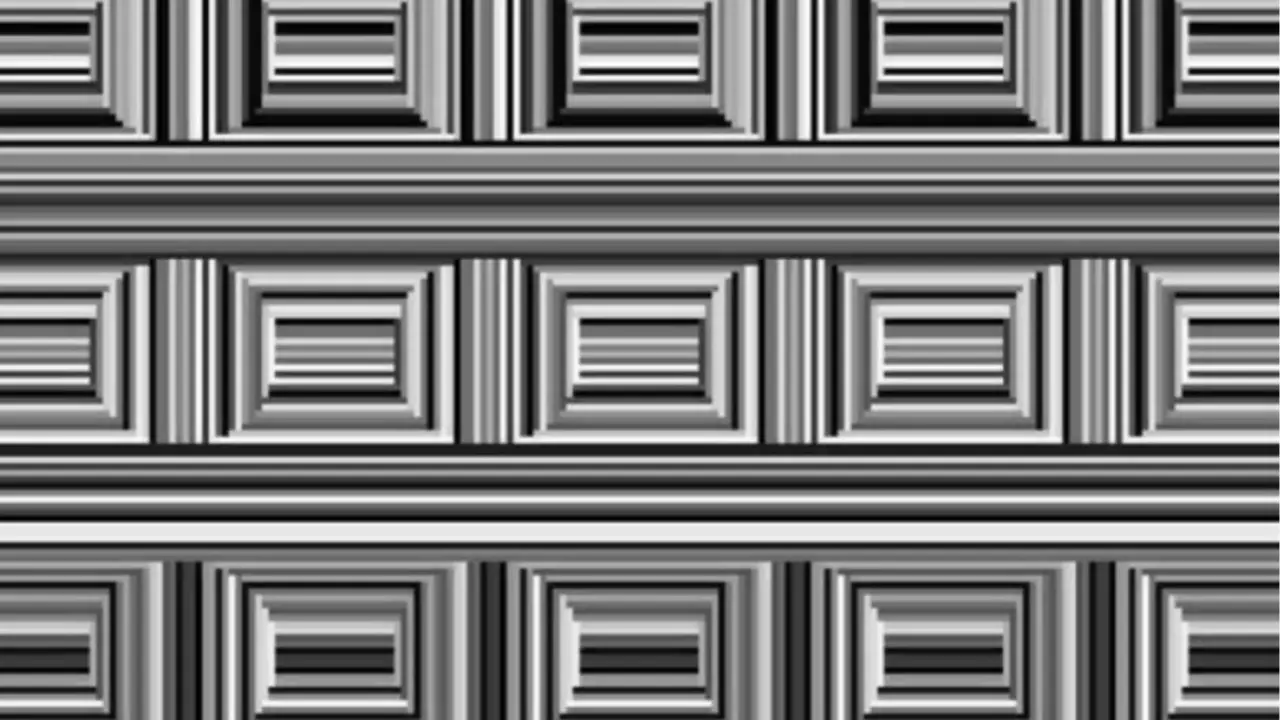
Credit: Kettlewell Eye Research Institute
Do You See Circles Or Squares? The Answer Depends On Where You Grew Up
An optical illusion that can be seen as circles or squares claims to depend on where you grew up.
It sounds like magic, but it’s actually true – there are optical illusions that you see differently depending on different factors about yourself.
You can learn what kind of personality you have, or whether you’re more powerful or private, depending on what you see.
But one particular illusion claims to be able to tell where you grew up, and it’s going viral.
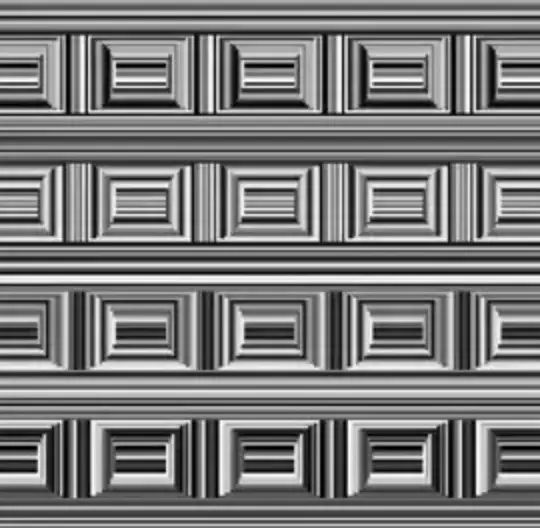
When you look at a grid of intersecting lines, what do you see first – squares or circles?
Revolutionary new research is challenging fundamental assumptions about human vision, suggesting that our cultural environments literally shape how we perceive the world around us.
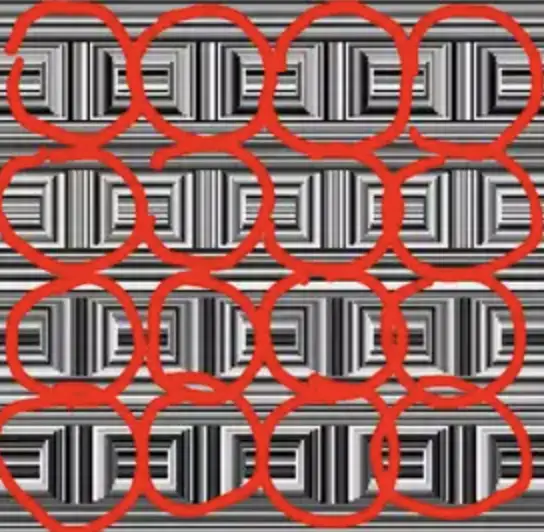
At the center of this groundbreaking study lies the Coffer illusion, a deceptively simple grid pattern that can be perceived as either squares or circles.
What researchers discovered defied expectations and sparked intense debate in the scientific community.
The results were staggering: 97% of U.S. and U.K. participants saw only squares or circles first, but 96% of Namibian Himba participants from traditional villages saw only circles or squares first.
This near-perfect reversal in perception between cultures suggests something profound about how our environments shape our vision.
“I’m surprised that you can’t see the round ones,” Uapwanawa Muhenije, a Himba woman from northern Namibia, tells Science.org.
The research, led by Ivan Kroupin at the London School of Economics, draws on a decades-old but controversial theory known as the ‘carpentered world hypothesis.’
This idea suggests that people from Western industrialized societies – often labeled as ‘WEIRD’ (Western, Educated, Industrialized, Rich, and Democratic) – develop different visual processing patterns due to their exposure to highly geometric environments.
“People in western industrialized countries see things in a specific way because they are generally exposed to highly ‘carpentered’ environments, with lots of straight lines, right angles – visual features common in western architecture,” explains Professor Anil Seth of the University of Sussex, a leading neuroscientist studying perception, in an article for The Guardian.
In contrast, the traditional Himba villages consist of round huts surrounding circular livestock corrals, creating a predominantly curved visual environment.
This environmental difference, researchers argue, fundamentally alters how the brain processes geometric information.
The Coffer illusion represents just one piece of a larger puzzle.
Jules Davidoff, a psychologist at the University of London who wasn’t involved in the study, emphasizes the significance of these findings: “There are other striking cultural differences in perception, but the one that they’ve produced here is a real humdinger.”
The study revealed profound differences across multiple illusions.
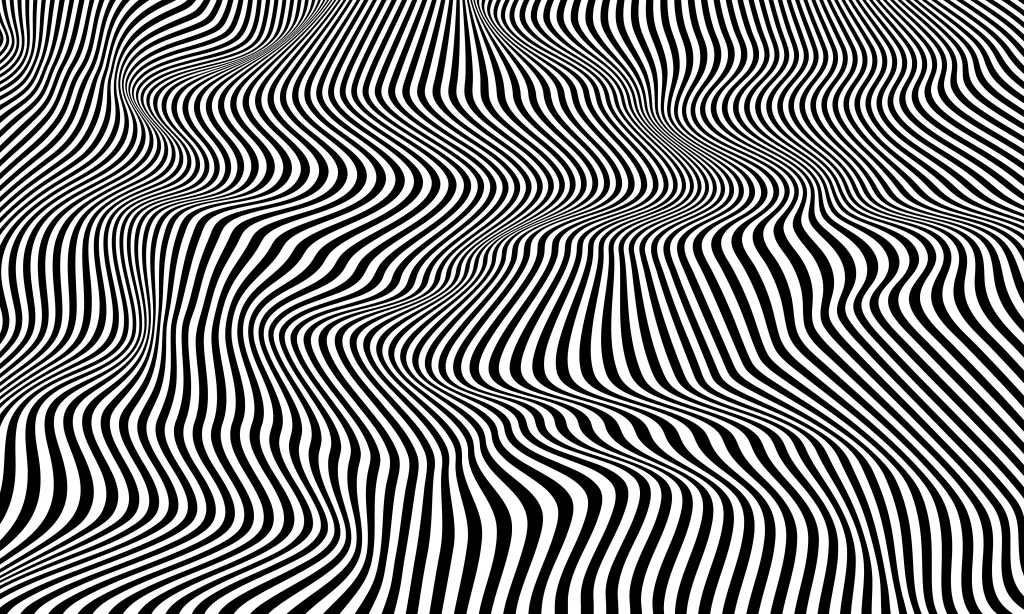
For instance, when shown wavy lines that typically appear as zigzags to Western observers, most Himba villagers saw the lines as they actually are: wavy.
Similarly, parallel lines that appear slanted due to surrounding patterns were correctly perceived as parallel by the Himba participants.
However, the field remains deeply divided.
A separate study by Dorsa Amir and Chaz Firestone directly challenges the carpentered world hypothesis, focusing on the famous Müller-Lyer illusion.
Their research demonstrates that this illusion affects non-human animals, works without straight lines, and even tricks people who have been blind from birth, suggesting that some visual illusions operate through more fundamental mechanisms than cultural conditioning.
“The jury remains out and – favourite scientist punt coming up – ‘more research is needed,'” admits Professor Seth, acknowledging the ongoing scientific debate.
The research carries profound implications for how we understand human perception and cognition.
Michael Muthukrishna, a co-author of the study, highlights the broader significance: “It shows the importance of diversity. If you’re trying to get a full picture of the world, you want to have some people in the room who see circles where you only see rectangles.”
Joseph Henrich, an evolutionary social scientist at Harvard University, warns that failing to account for cultural differences risks ‘mislabeling things as universal human features when in fact they are side effects of the researchers’ own culture –a culture that is unusual by global and historical standards.’
The research methodology involved significant logistical challenges.
While participants in the U.S. and U.K. completed online surveys, the Namibian portion required extensive fieldwork.
Kroupin worked directly with Himba communities, guided by co-author Helen E. Davis, an anthropologist at Arizona State University.
This methodological difference has drawn some criticism, with researchers noting that the varying presentation methods could potentially influence results.
Additionally, participants from a semi-urban Namibian town showed intermediate results, falling between the rural Himba and Western urban patterns, suggesting a gradient effect rather than a simple binary difference.
To address these questions more comprehensively, researchers at the University of Sussex and University of Glasgow are conducting the Perception Census, an ambitious project studying how perception differs across approximately 40,000 people from more than 100 countries.
“Our experiment includes not just one or two visual illusions but more than 50 different experiments probing many different aspects of perception,” explains the research team.
“When we’re done analysing the data, we hope to deliver a uniquely detailed picture of how people experience their world, both within and between cultures.”
Professor Seth concludes: “How things seem is not how they are.”
Related Article: People Are Seriously Struggling To Work Out Which Building Is Closer In Viral Photo
Related Article: You Have A High IQ If You Can Spot Hidden Tiger In Jungle Photo In Just 12 Seconds
Want more stuff like this?
Get the best viral stories straight into your inbox!
