
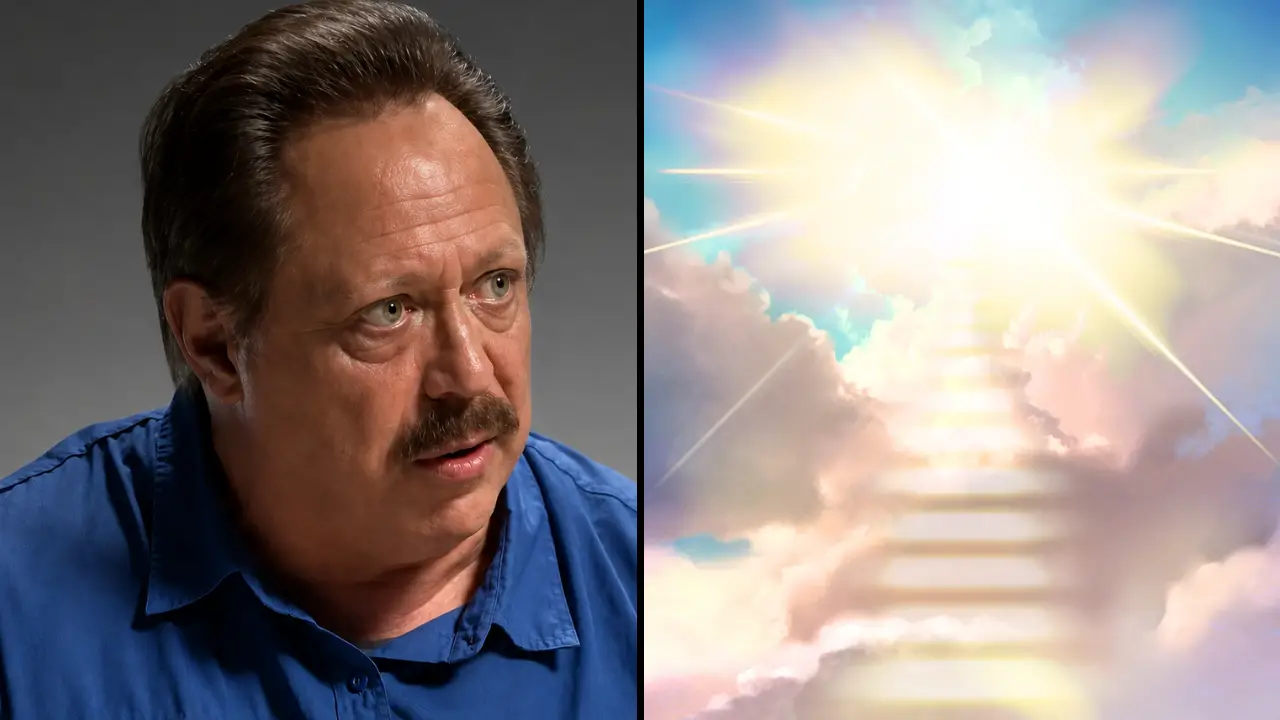
Credit: CTMU Radio via YouTube & Adobe Stock
‘World’s Smartest Man’ Explains What Happens After Death
The world‘s ‘smartest man’ has explained what he thinks happens after death.
For thousands of years, humans have asked the same impossible question: what actually happens after we die?
Religions, philosophers, scientists, and spiritual thinkers have all tried to explain what may await beyond death, yet no answer has ever been universally accepted.
Some believe consciousness simply ends, while others argue the soul continues into another existence.
Now, a man often described as the ‘world’s smartest person’ has shared his own extraordinary theory, and it is unlike anything most people have heard before.
Chris Langan, an American horse rancher and self-taught intellectual, is believed to have an IQ estimated somewhere between 190 and 210. That figure would place him significantly above Albert Einstein, whose IQ is generally estimated to be around 160.
Over the years, Langan has become known not only for his intelligence but for developing an ambitious theory known as the Cognitive-Theoretic Model of the Universe, or CTMU.
The theory attempts to explain reality itself, combining ideas from science, mathematics, philosophy, consciousness, and metaphysics into what Langan describes as a true ‘Theory of Everything.’
One of the most fascinating aspects of his theory involves death and what may happen to human consciousness after physical life ends.
According to Langan, death is not the end of existence at all.
Instead, he believes it represents a transition into another level of reality entirely.
Who is Chris Langan, and why do people call him the world’s smartest man?
Chris Langan has fascinated the public for decades because of his reportedly extraordinary intelligence and unconventional life story.
Despite being described as one of the most intelligent people alive, Langan did not follow a traditional academic path.
Instead of becoming a university professor or scientist working in a major research institution, he spent much of his life working blue-collar jobs, including construction and horse ranching.
Born in San Francisco in 1952, Langan reportedly demonstrated exceptional intellectual abilities from a very young age.
According to various interviews, he taught himself advanced subjects independently and developed a passion for understanding the deepest questions surrounding existence and reality.
Over time, he began developing the CTMU, a highly complex framework attempting to explain how consciousness and reality are interconnected.
Although the theory has attracted criticism from some academics who argue it lacks mainstream scientific validation, others remain fascinated by its philosophical ideas and ambitious scope.
Langan himself argues that reality cannot be understood purely through traditional physics or material science. Instead, he believes consciousness plays a fundamental role in shaping existence itself.
This belief ultimately led him to develop his ideas about what happens after death.
Chris Langan’s beliefs about death
During an appearance on the Theories of Everything podcast hosted by Curt Jaimungal, Langan explained his view of death in surprisingly calm and philosophical terms.
Rather than seeing death as total annihilation, he described it as the ending of one specific relationship — the connection between consciousness and the physical body.
“The termination of your relationship with your particular physical body that you have at this present time,” Langan said when asked to define death.
According to his theory, consciousness is not created solely by the brain. Instead, he believes consciousness exists as part of a much larger universal structure.
When the body dies, Langan argues that consciousness does not disappear. Instead, it returns to what he describes as the ‘origin of reality.’
“When you are retracted from this reality, you go back up toward the origin of reality,” he explained.
Langan’s theory suggests that human existence operates somewhat like layers within a larger informational system. Physical reality is only one level of that system, while consciousness itself exists beyond purely material form.
He even claims that after death, consciousness may continue existing through what he described as a ‘substitute body’ in another dimension or plane of reality.
Although the idea sounds similar to religious concepts of the soul, Langan says his theory differs from traditional ideas about heaven or the afterlife.
Instead, he views death as a transformation into an entirely new mode of existence.
What happens to memories and identity after death?
One of the most intriguing parts of Langan’s explanation concerns memory and personal identity after physical death.
Many people wonder whether consciousness continuing after death would also mean carrying memories, emotions, and experiences from earthly life into another realm.
According to Langan, memories are not necessarily erased — but they may no longer matter in the same way.
“Your memories can always be pulled back out, but there’s no reason to do that usually,” he said during the podcast interview.
He continued: “Why cling to memories of a world in which you are no longer instantiated?”
Langan believes the post-death state involves such a dramatic shift in existence that attachment to physical life becomes largely irrelevant.
He compared the experience to a meditative state where reality changes form while remaining deeply interconnected underneath.
One of his more unusual claims involves the idea that all lifetimes may exist simultaneously outside normal human understanding of time.
“Arguably, all of your lifetimes… all of those reincarnations are meta-simultaneous,” he explained.
“There is a sense in which they all occur at once in the non-terminal domain.”
In simple terms, Langan suggests that linear time may only exist within physical reality. Outside of it, consciousness could experience existence in an entirely different way where past, present, and future are interconnected.
The idea resembles certain philosophical and spiritual beliefs about reincarnation, multidimensional existence, and timeless consciousness, although Langan frames his explanation within the structure of the CTMU rather than religion.
The three core ideas behind his theory of reality
At the center of Langan’s ideas about death is the CTMU itself.
He describes the theory as an attempt to explain the structure of reality through logic, information, and consciousness.
According to Langan, the model rests on three major assumptions.
The first is that reality is fundamentally made of information and language.
In his view, the universe behaves almost like a self-processing system where reality continuously generates and interprets itself. Instead of seeing matter as the deepest level of existence, Langan argues that information is the true foundation of reality.
The second concept is what he calls ‘transtemporality.’
This refers to the idea that events across different timelines may influence one another. In other words, time is not necessarily fixed in the straightforward way humans normally experience it.
According to the CTMU, different points in time could remain interconnected within a larger universal structure.
Finally, Langan believes reality includes a form of ‘panconsciousness.’
This idea suggests consciousness exists throughout the universe itself rather than being limited only to living brains. He describes reality as a self-simulating system emerging from a creator or universal source of intelligence.
These ideas form the basis for his belief that consciousness survives beyond bodily death.
Although mainstream scientists generally do not accept the CTMU as proven science, the theory has continued attracting attention online because it attempts to answer questions many people have wondered about for centuries.
Related Article: Woman Pronounced Dead For 15 Minutes Describes Her ‘5 Years In Heaven’
Related Article: Boy Claims He’s Reincarnated And Has Eerily Perfect Memory Of Hollywood Star
Want more stuff like this?
Get the best viral stories straight into your inbox!
