
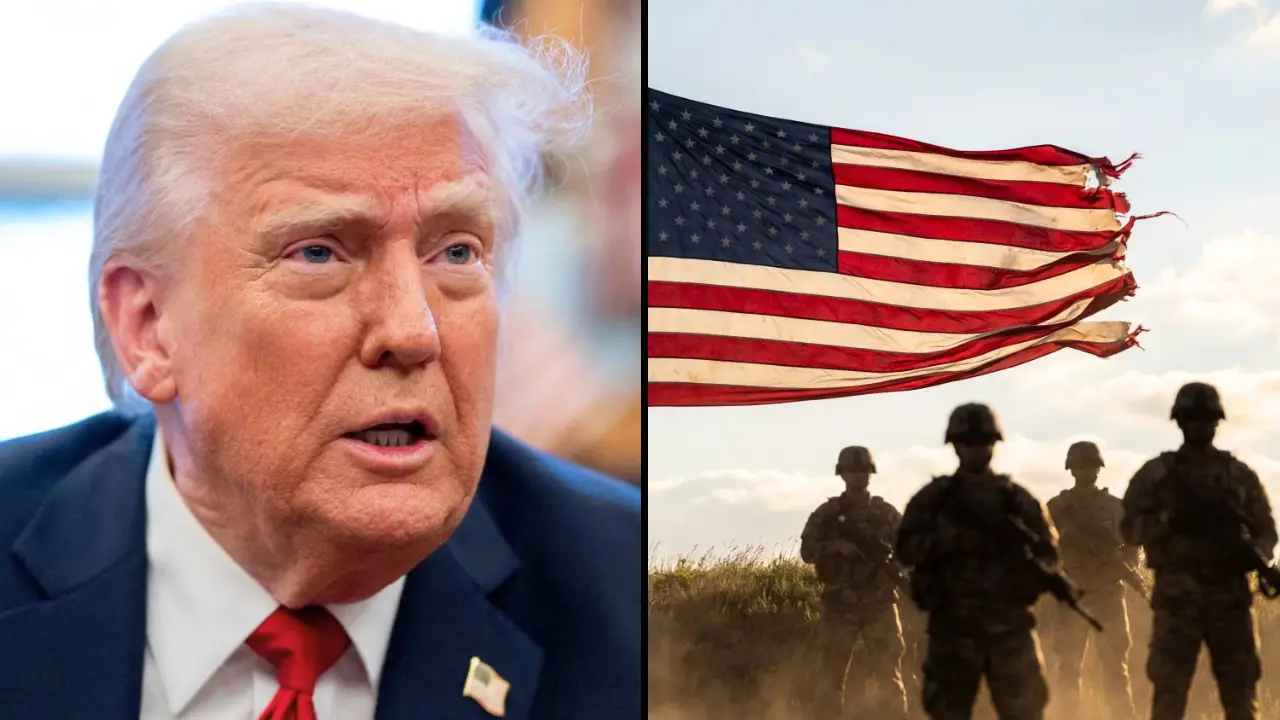
Credit: Alamy & Adobe Stock
Full List Of US Draft Exemptions As Maximum Age Of Military Enlistment Is Raised Significantly
The maximum age for military enlistment in the US has been raised as people research potential draft exemptions.
Nearly four weeks since the United States and Israel launched coordinated strikes on Iran on February 28, the conflict shows no sign of reaching a swift conclusion.
Despite President Donald Trump‘s repeated assurances that the military operation would be wrapped up within a matter of weeks, the reality on the ground tells a different story.
At least 13 American service members have been killed, more than 200 have been injured, and the death toll on the Iranian side continues to climb, with some rights groups estimating as many as 3,230 people have died as of March 21.
The original justification for the strikes centered on eliminating Iran’s nuclear capabilities and long-range missile program, both of which the US and Israel had long described as existential threats to regional stability and Western security.
The killing of Supreme Leader Ayatollah Ali Khamenei on the first day of strikes was framed as part of a broader regime change mission.
But with Khamenei gone and the bombardment continuing, questions have multiplied over what exactly the endgame looks like — and whether American boots on the ground might eventually be part of the answer.
Those questions are no longer theoretical for millions of American families.
World War Three fears loom large
The war in Iran has not remained contained to Iran. Israel has launched attacks in Lebanon. Iranian drones have struck neighboring countries in retaliatory waves. Gulf Arab energy infrastructure has been repeatedly targeted.
Explosions have rocked Dubai. NATO has repositioned hundreds of personnel from Iraq to Europe after Iranian strikes hit British, French, and Italian installations.
The ripple effects have alarmed some of the world‘s foremost military minds. Richard Shirreff, the former deputy supreme allied commander of NATO in Europe, stated he cannot recall a more dangerous moment in geopolitics in his lifetime, warning that a ‘growing sense in the Western military community’ suggests the crisis has already spiraled out of control.
His concern is not limited to the Middle East: should the United States become entangled in a ground war in the region, Shirreff argues that China and Russia would not hesitate to capitalize on the distraction.
Beijing, in his assessment, could seize the moment to pursue its ambitions regarding Taiwan, potentially as soon as 2027.
NATO Secretary General Mark Rutte has separately warned that the West must be prepared for a scale of warfare not seen since the era of our grandparents and great-grandparents.
Against this backdrop, it is little wonder that talk of a military draft has moved from fringe concern to mainstream anxiety practically overnight.
The White House refuses to rule out the draft
The source of much of that anxiety can be traced directly to the words of White House Press Secretary Karoline Leavitt.
When asked directly about the prospect of a draft during an appearance on Fox News, Leavitt did not close the door.
“President Trump wisely does not remove options off of the table,” she said. “The president, as commander-in-chief, wants to continue to assess the success of this military operation. It’s not part of the current plan right now, but the president, again, wisely keeps his options on the table.”
She also declined to rule out the possibility of American troops being deployed on the ground inside Iran.
The comments landed like a thunderclap across the country. For the first time in over 50 years (the last draft call was issued in 1972 during the Vietnam War) the machinery of conscription has become a live topic of national conversation rather than a historical footnote.
Adding further unease, Trump’s former counter-terrorism chief Joe Kent resigned last week, urging the administration to reverse course in Iran.
In his resignation letter, Kent claimed the war was unjustified because Iran posed no imminent threat to the United States when the strikes were launched, and alleged that the administration had entered the conflict due to pressure from Israel and its American lobby.
The White House dismissed his letter entirely, stating it had compelling evidence that Iran had been planning to attack the US.

The Army Makes a Significant Change
It was against this unsettled backdrop that the US Army announced a notable change to its enlistment requirements — one that has done little to calm nerves.
Effective April 2026, the maximum enlistment age for new Army recruits has been raised from 35 to 42 years old, per Delaware Online.
The minimum age remains 17 with parental consent, or 18 without. The change brings the Army more in line with other branches of the military.
The Navy and Coast Guard currently accept recruits up to 41 years old. The Air Force and Space Force already operate with a maximum age of 42. The Marine Corps remains the most restrictive, capping enlistment at 28.
Alongside the age change, the Army also quietly removed the requirement for a formal waiver for recruits who have a single prior conviction for marijuana possession or drug paraphernalia.
The combination of changes effectively broadens the pool of Americans who are eligible to enlist.
The announcement came as the Pentagon confirmed plans to deploy at least 1,000 troops from the 82nd Airborne Division to the Middle East in the coming days, alongside three additional warships and roughly 2,500 Marines already dispatched to the region.
Officials stated that while no decision had been made to send troops into Iran itself, the US was building up its capacity for future operations.
How would a draft actually work?
While there is no active draft and one has not been formally proposed, the infrastructure to implement one is fully operational for the first time in decades.
The 2026 National Defense Authorization Act has implemented automatic Selective Service registration, meaning the US government can now use federal records — including DMV and Social Security data — to register eligible citizens rather than relying on self-registration.
Under existing law, all male US citizens and male immigrants between the ages of 18 and 25 are required to be registered with the Selective Service System.
Failing to register is a federal felony, carrying penalties of up to five years in prison and fines of up to $250,000. It can also result in loss of eligibility for federal student loans, federal employment, and — for immigrants — a path to citizenship.
Should a draft be authorized, it would require approval from both Congress and the President’s signature, and would only be considered after active-duty military, National Guard, Reserves, and new volunteers had been deemed insufficient to meet the military’s personnel needs.
If a draft lottery were triggered, it would be conducted publicly — nationally televised and live-streamed — with birthdays drawn at random to establish the order of induction.
Those turning 20 in the year of the lottery would be called first, followed by those aged 21, 22, 23, 24, and 25, then working back down through 19 and finally 18.
Women are not currently required to register for Selective Service and cannot be drafted under existing law, though discussions about expanding registration requirements have taken place without any resulting legislation.
The full list of draft exemptions
Despite the heightened state of military readiness, not everyone would be eligible to be called up, and the Selective Service maintains a specific list of exemptions and deferments that would apply if a draft were reinstated.
Those fully exempt — meaning not required to register or serve at all — include non-immigrant men in the US on valid student, tourist, visitor, or diplomatic visas, provided they remain on that visa until they turn 26.
Men already serving on active duty in the US Armed Forces are also exempt, as are cadets and midshipmen at service academies such as West Point and Annapolis, students at certain military colleges, and individuals who are currently incarcerated or institutionalized, though the latter must register within 30 days of release.
Beyond outright exemptions, a separate category of deferments exists for those who are registered but may be excused from active combat service.
Ministers and divinity students must register but can claim a Ministerial Deferment if a draft is activated. Individuals who serve as the sole financial support for dependents — such as young children or elderly parents — can apply for a Hardship Deferment.
Conscientious objectors, those who can demonstrate that their opposition to war is rooted in sincere moral, ethical, or religious belief, may be assigned to non-combatant military service or a civilian alternative program rather than frontline duty.
Those with significant medical conditions, chronic illnesses, physical disabilities, or serious psychological disorders would likely receive a deferment or full exemption following evaluation at Military Entrance Processing Stations.
It is also worth noting that dual nationals — Americans who hold citizenship in another country — are still legally required to register with the Selective Service within 30 days of their 18th birthday, regardless of whether they live inside or outside the United States.
Related Article: New Website Demands Barron Trump Is Drafted As People Learn He Can’t Join Military
Related Article: Severe Punishment You Could Face If You Refuse The Draft Amid WW3 Fears
Want more stuff like this?
Get the best viral stories straight into your inbox!
